Face Yoga: What the Actual Research Shows (Separate From What Influencers Claim)
Quick Answer: The evidence base is small. The few published studies — mostly tiny samples, short durations, often no control group — found modest improvements in facial muscle tone and fullness after 8+ weeks of near-daily practice. Dramatic wrinkle-reversal claims have no support at that level.
There’s a specific gap worth naming: between what face yoga content promises and what has actually been measured, there sits a very small pile of papers.
Not zero. Just much smaller than the confidence in the average before-and-after caption.

Why do the claims outrun the evidence?
The number of well-designed clinical studies testing facial exercise protocols is genuinely limited compared to the volume of confident claims circulating online.
The studies that do exist carry real methodological limits — small samples, short durations, frequently no control group. That reduces how much weight any specific finding can carry, as our honest guide covers in more depth.
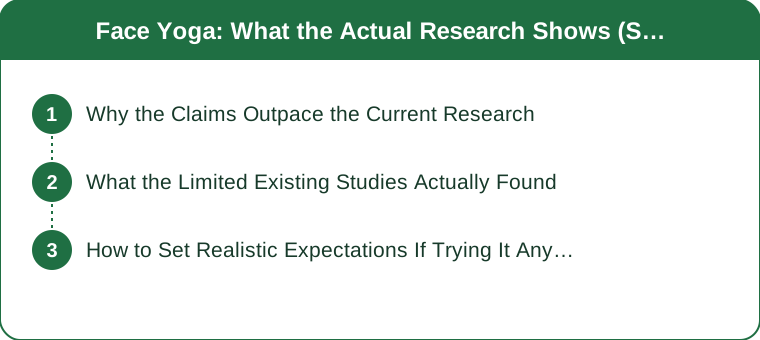
Popular content also tends to lean on testimonials and photo pairs rather than referencing that research at all, which is how a modest finding becomes a dramatic promise.
Then there’s the biology. Visible skin aging involves several distinct mechanisms — collagen loss, facial fat pad shifts, elasticity changes — that muscle exercise doesn’t directly address, even if it does improve muscle tone. And a free, accessible intervention is emotionally appealing enough to generate real motivated reasoning independent of the evidence.
What did the studies actually find?
- Modest, measurable improvement in specific facial muscle characteristics with sustained regular practice over weeks to months. Not transformation.
- Protocols ran 8 weeks or longer before outcomes were measured. Occasional or inconsistent practice is simply not what was tested.
- Outcomes skewed toward muscle-related change — tone, fullness — rather than the wrinkle-reduction claims that get marketed hardest.
- Circulation and tension release have more straightforward physiological plausibility than structural anti-aging claims. Facial massage sits in similar territory.
- The strongest marketed claims have no research support at the level claimed. That gap is the honest headline here.

Myth vs Fact
Myth: Face yoga is “a workout for your face,” so it builds facial muscle like squats build glutes. Fact: Facial muscles differ structurally from skeletal muscles — many attach directly to skin rather than bone. The training analogy is looser than it sounds.
Myth: More intensity means faster results. Fact: Nothing in the research supports aggressive technique, and repeated forceful movement is a plausible way to irritate skin. Consistency beats intensity is the better-supported approach.
Myth: Results show up in two weeks. Fact: Studied protocols measured at eight weeks or more. A two-week transformation claim is a red flag about the source, not a finding about the practice.
Myth: It can replace sun protection or skincare. Fact: Nothing here touches photoaging, which is the dominant driver of visible skin change. Sunscreen remains the intervention with the strongest evidence behind it by a very wide margin.
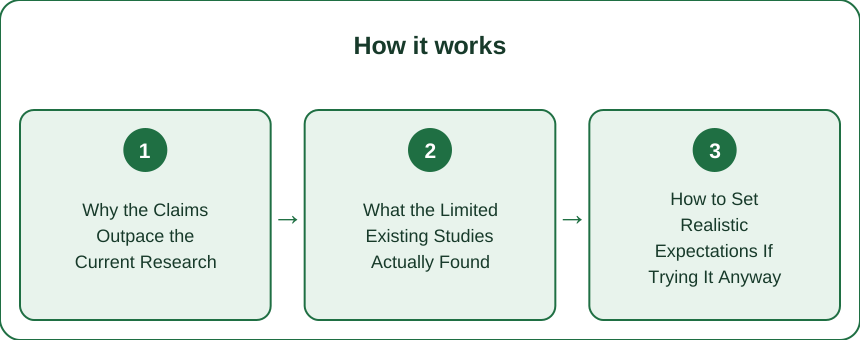
How should you set expectations if you want to try it anyway?
Aim at relaxation and circulation. Frame the goal around what has plausible mechanistic support rather than the dramatic anti-aging pitch. That framing is also much harder to be disappointed by.
Commit to the tested timeline. If you’re genuinely testing it, give it the same sustained multi-week consistency the research used — eight weeks or more of near-daily practice, not a handful of sporadic attempts.
Keep the fundamentals. Sun protection stays the priority regardless. Face yoga addresses a different and much narrower part of the skin-aging picture.
Value the ritual on its own terms. Ten quiet minutes of deliberate facial and jaw relaxation may be worth doing whether or not anything measurable changes. That’s a legitimate reason.
Treat speed claims as a red flag. Given what the actual research timeline shows, “dramatic results in ten days” tells you about the marketer, not the method.
When to see a professional: talk to a dermatologist before starting if you have active acne, rosacea, eczema, recent facial surgery, or dermal fillers, since repeated manipulation can aggravate some conditions. Persistent jaw pain, clicking, or headaches point toward a dentist or physician for TMJ assessment rather than more exercises. And if a specific cosmetic outcome matters to you, a dermatologist can tell you plainly which interventions have evidence behind them for that goal.
FAQ
How long until face yoga shows results?
Based on the studied protocols, think in months rather than weeks — eight weeks of consistent daily practice was typically the minimum before measurement. Our realistic timeline guide breaks down what tends to change first.
Can face yoga cause wrinkles?
It’s a common worry and the evidence is thin either way. Repeated forceful expression-making is the theoretical concern; gentle, controlled technique is the sensible hedge. If a movement feels like it’s creasing skin hard, ease off.
Is it worth doing at all, then?
That depends what you want from it. For relaxation, jaw tension relief, and a consistent facial care ritual — reasonable. For reversing visible aging — the evidence doesn’t currently support that expectation, and sunscreen and a dermatologist will do more.
TL;DR:
- The evidence base is small, methodologically limited, and much narrower than the marketing.
- Studies found modest muscle tone and fullness changes after 8+ weeks of consistent practice — not wrinkle reversal.
- Circulation and tension release are the more plausible benefits; dramatic anti-aging claims lack support.
- Skin aging runs on collagen loss, fat pad shifts, and elasticity — mechanisms facial exercise doesn’t directly address.
- If testing it, commit to the real 8-week timeline and keep sun protection as the priority.
- See a dermatologist first with active skin conditions, recent procedures, or fillers; persistent jaw pain needs a professional, not more reps.
Keep Reading
This article is for general informational and styling purposes only. Fit, sizing, and product availability may vary.