The Two-Minute Face Yoga Reset for a Day of Video Calls
Quick Answer: Video calls produce a distinct tension pattern: a held brow from concentration, a clenched jaw from screen focus, and forward head posture that shortens the front of the neck. A two minute reset that addresses all three between calls is more useful than a ten minute routine at the end of the day, because the tension is being reinforced hourly. The sequence is brow release, jaw unclench, tongue-to-palate reset, and a neck lengthener, roughly thirty seconds each.
The reason this is worth its own routine is that the pattern is specific and predictable, which means the fix can be too.

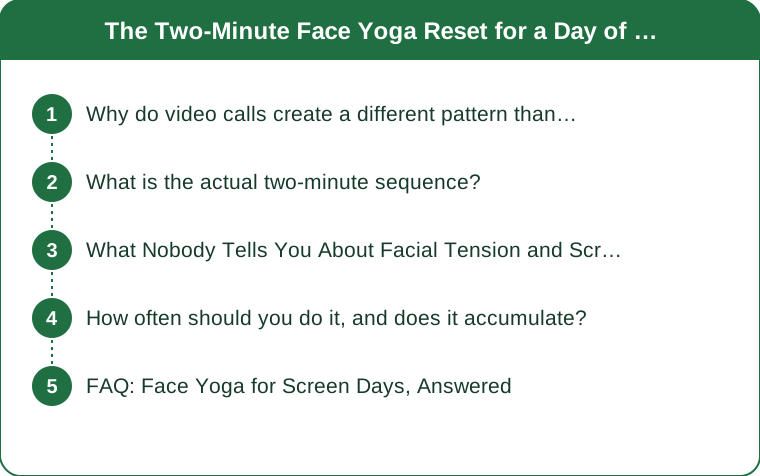
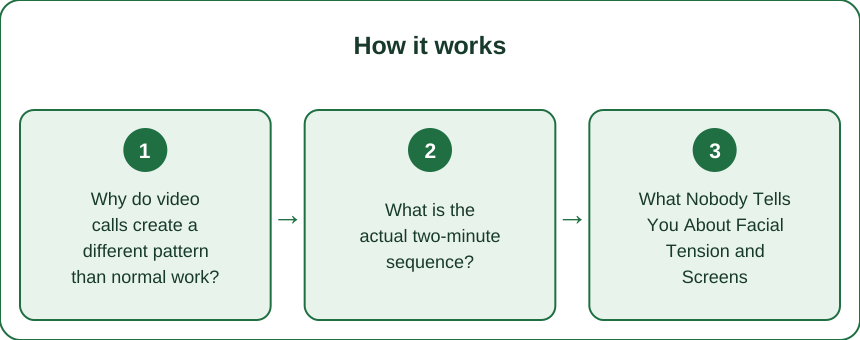
Why do video calls create a different pattern than normal work?
Three things happen on a call that do not happen while working alone.
The first is self-monitoring. Seeing your own face on screen means you are unconsciously managing your expression for hours, which involves low-level continuous activation of the muscles around the eyes and mouth. That is genuinely tiring in a way silent work is not.
The second is listening posture. Concentrating on someone speaking through a slightly imperfect audio connection produces a subtle forward lean and a raised brow, both of which are held rather than intermittent.
The third is jaw position. Most people rest with the jaw slightly clenched and the teeth in contact while focusing on a screen, when the anatomically resting position has the teeth apart and the tongue on the palate. Six hours of low-level clenching is a meaningful load on the masseter.
The forward head posture ties them together. Every couple of centimetres the head moves forward substantially increases the load on the neck extensors, and the muscles of the jaw and the front of the neck are directly connected to that chain.
So the tension is not really facial. It starts postural and expresses itself in the face.
What is the actual two-minute sequence?
Four movements, roughly thirty seconds each, done sitting up with both feet on the floor.
1. Brow release. Place your fingertips just above the eyebrows and press gently upward and outward while you actively try to frown against the resistance for five seconds, then release completely. Repeat three times. The releasing is the part that matters; the contraction just makes the release more complete.
2. Jaw unclench. Let your mouth fall slightly open so the teeth are not touching. Place your fingertips on the masseter, the thick muscle at the angle of the jaw, and make slow small circles with light pressure for about twenty seconds each side. If you find a tender spot, hold gentle steady pressure rather than digging.
3. Tongue-to-palate reset. Close your lips, keep the teeth apart, and rest the whole tongue flat against the roof of the mouth. Breathe through your nose for five slow breaths. This is the anatomically neutral resting position and it directly discourages clenching.
4. Neck lengthener. Tuck the chin slightly, as though making a small double chin, lengthen the back of the neck upward, and hold for five seconds. Repeat five times. This counteracts the forward head position that everything else is downstream of.
That is the whole thing. Doing it between two calls beats doing it once at six p.m.

What Nobody Tells You About Facial Tension and Screens
You cannot feel a low-level clench. Masseter tension at ten percent of maximum is completely below conscious awareness and can be sustained for hours, which is why people are genuinely surprised to find their jaw tender to touch at the end of a day where nothing felt wrong.
The brow is the earliest indicator. If you catch yourself with raised eyebrows during a call, that is usually a sign that you are straining to hear, and turning the volume up or using headphones solves the facial tension more effectively than any exercise.
Camera height matters more than any of this. A laptop on a desk puts the camera below eye level, which forces you to look down and pushes the head forward. Raising the laptop so the camera sits at eye level removes the postural driver entirely, and it is a stack of books.
Hiding your self-view is a legitimate intervention. Most platforms allow it, and the reduction in self-monitoring is noticeable within a day for many people.
And the tension often shows up somewhere unexpected: headaches at the temples, ear fullness, or tooth sensitivity, all of which are common referrals from a tight masseter. If any of those are persistent, or if you have jaw clicking, locking, or pain that limits opening, that is a conversation with a dentist or a physiotherapist rather than a self-care routine. This is general information, not medical advice.
How often should you do it, and does it accumulate?
Frequency beats duration for this, in the same way it does for any tension that is being continuously reinforced.
Twice a day is a reasonable minimum and produces noticeable difference within about two weeks for most people. Between every call is ideal and unrealistic; between the two longest calls is achievable.
The effects on tension are immediate and short-lived at first. Over several weeks the resting tone of the muscles changes, which is when people report the jaw simply not being tight at the end of a day rather than needing to be released.
The postural component takes longer, because you are changing a habit rather than releasing a muscle. Camera height and a chin-tuck cue do most of that work, and the exercises support it.
What to expect visually, honestly: this routine is about comfort rather than appearance, and the visible changes people associate with face yoga come from longer and more consistent practice over months. Releasing a clenched jaw does soften the lower face for some people, which is a pleasant side effect rather than the point.
Set one recurring calendar reminder rather than trying to remember. The reason this routine fails is never difficulty; it is that a day of calls consumes all available attention.
FAQ: Face Yoga for Screen Days, Answered
Can I do this on camera during a call?
The tongue-to-palate reset and the chin tuck are both invisible and can be done while listening. The other two involve hands on the face, so save them for the gaps.
Is jaw massage safe to do daily?
Light self-massage of the masseter is generally fine daily. Avoid heavy pressure, avoid the joint itself just in front of the ear, and stop if it produces pain rather than relief.
Will this help with grinding at night?
It may reduce daytime tension that contributes to it, and night grinding is a separate issue with its own causes. If you grind at night, a dentist can assess for wear and discuss a guard.
What if I get a headache after calls?
Tension headaches from this pattern are common and usually respond to the postural fixes more than the facial ones. Persistent or severe headaches should be assessed by a professional rather than managed with exercises.
TL;DR:
- Video calls produce a specific pattern: held brow, clenched jaw, forward head.
- The two minute reset is brow release, masseter circles, tongue-to-palate, and chin tucks.
- Doing it between calls beats a longer routine at the end of the day, because the tension is being reinforced hourly.
- Raising the camera to eye level and hiding your self-view fix the causes rather than the symptoms.
- Jaw pain, clicking, or locking is a professional question, not a routine question.
Most of what feels like facial fatigue after a day of calls is a posture problem wearing a facial disguise.
Keep Reading
This article is for general informational and styling purposes only. Fit, sizing, and product availability may vary.