How to Tell If You Are Doing Face Yoga Too Hard
Quick Answer: You are doing too much if you get jaw or temple soreness that lasts into the next day, headaches after sessions, new redness or irritation, deepening of the exact lines you are targeting, or if you find yourself holding tension in your face between sessions. Facial muscles are small and attach directly to skin rather than to bone at both ends, so they respond to light, frequent work and react badly to force. Reduce pressure first, then duration, then frequency.
The logic that works in the gym does not transfer to your face. More resistance, more reps, and more intensity produce a different result here, and quite often the opposite of the one you wanted.

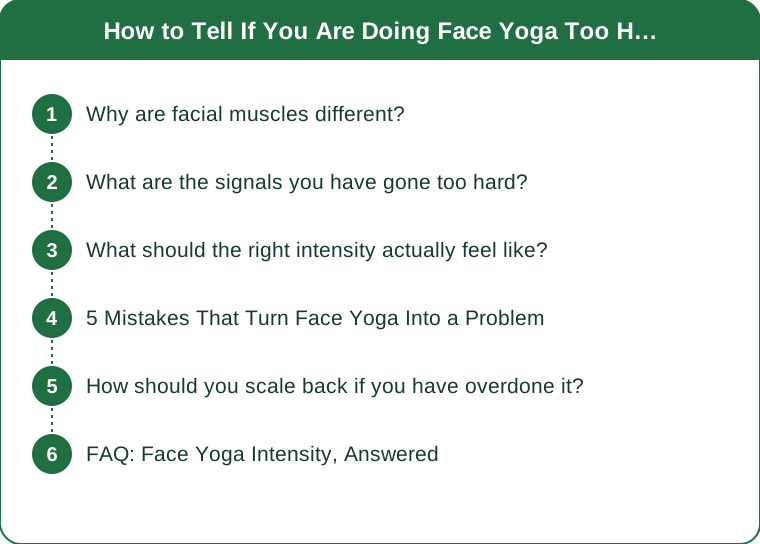
Why are facial muscles different?
Most of them attach to skin rather than to bone at one end. Skeletal muscles pull bone against bone. Facial muscles pull skin, which is why they produce expression - and it is why aggressive contraction directly creases the skin you are trying to smooth.
They are also very small and have a high density of motor units, which means they fatigue and cramp more readily than large muscles and recover on a different timeline.
They are already active all day. Unlike a glute or a lat, your facial muscles have been working continuously since you woke up - talking, expressing, squinting at a screen. You are never starting from rest.
And several of them are chronically overactive in most people rather than weak. The jaw muscles in particular are usually holding too much tension already, which means adding resistance work to them makes the problem worse rather than better.
So the training logic inverts. For much of the face, the goal is release and control rather than strengthening, and applying a gym mindset produces exactly the tension patterns that create the lines people are trying to soften.
What are the signals you have gone too hard?
Soreness that lasts into the next day. A mild working sensation during a session is fine. Jaw, cheek, or temple soreness the following morning means you overloaded small muscles that did not need it.
Headaches after sessions. Usually temporal or behind the eyes, and usually from over-engaging the jaw or the frontalis. This is the most common overdoing-it signal and it should stop the session immediately.
Redness, irritation, or broken capillaries. Facial skin is thin and the pulling and pressure involved in some techniques can cause real irritation, especially on sensitive or rosacea-prone skin.
Deepening of the lines you are targeting. If the line between your brows or around your mouth looks more set after several weeks, you are likely creasing the skin during the exercises rather than releasing the muscle underneath.
Holding tension between sessions. Noticing that your jaw is clenched or your brow is furrowed at random moments in the day is a sign that you have taught your face a new tension habit.
Clicking, catching, or pain in the jaw joint. This is a stop signal, not a scale-back signal, and it warrants a professional opinion - jaw joint problems are not something to work through.
What should the right intensity actually feel like?
Light. The pressure of your fingertips should be roughly what you would use to apply moisturiser, not what you would use for a massage.
Isolated. You should be able to move one area while the rest of your face stays relaxed. If your jaw clenches when you work your eyes, or your brow lifts when you work your cheeks, the movement is not isolated and the extra tension is where the trouble comes from.
Short. Five to ten minutes is a full session for most protocols. Twenty or thirty minutes is where people report headaches and jaw soreness.
Frequent rather than intense. The pattern that suits facial muscles is short, light, near-daily work - similar in principle to mobility work rather than to strength training.
And you should finish looking relaxed, not flushed. A face that is red and tight after a session has been worked too hard, and the flush is not a sign of circulation benefit.

5 Mistakes That Turn Face Yoga Into a Problem
1. Adding your fingers as resistance everywhere. Resistance has a place in a few specific movements and is over-applied generally. If a routine has you pressing hard against your own face for most of it, it is likely to create more creasing than benefit.
2. Working the jaw muscles as if they are weak. For most people the masseter is overactive, not underactive. Chewing exercises and jaw clenching work is the most common way people make jaw tension and headaches worse.
3. Doing it with dry hands on dry skin. Friction on facial skin causes irritation and tugging. Use a small amount of oil or serum so fingers glide rather than drag.
4. Practising in front of a mirror while frowning at yourself. Concentration frown is real, and people spend ten minutes reinforcing the exact brow line they came to fix. Check in the mirror occasionally rather than staring throughout.
5. Stacking it with other facial treatments. Face yoga on the same day as strong actives, microneedling, or a facial treatment increases irritation. Leave a day between, and skip it entirely on the days after any professional treatment.
How should you scale back if you have overdone it?
Take three to five days off completely. Facial muscle soreness resolves quickly with rest, and there is no meaningful detraining effect in that window.
Restart at half the duration and a third of the pressure. Five minutes, fingertips barely resting.
Drop the specific movements that produced the symptom. If your temples ached, cut brow work. If your jaw was sore, cut everything involving the jaw and replace it with jaw release - warm compress, gentle massage of the masseter, and letting the jaw hang slack for a minute.
Add relaxation work before strengthening work. Most people’s faces need release first. A minute of conscious relaxation - jaw slack, tongue resting on the roof of the mouth, brow smooth - before any exercises changes the quality of the whole session.
Watch for the return of the same signal. If soreness or headaches come back at the reduced level, the issue is the technique rather than the volume, and it is worth having someone qualified look at what you are doing.
And take skin irritation seriously as its own thing. Persistent redness, broken capillaries, or a flare of an existing skin condition are reasons to stop and speak to a dermatologist rather than to reduce and continue.
This is general information, not medical advice.
FAQ: Face Yoga Intensity, Answered
Can face yoga cause wrinkles?
Repeatedly and forcefully creasing the skin in the same place is the mechanism behind expression lines, so technique that involves hard contraction of the muscles under an existing line is a reasonable thing to be cautious about. Light, isolated, controlled movement is a different proposition from forceful repetition.
How sore should I be after a session?
Ideally not at all the next day. A mild working sensation during the session that fades within an hour is the ceiling worth aiming for.
Is it safe if I have TMJ or jaw problems?
Speak to your dentist or physiotherapist first. Many jaw conditions are aggravated by exactly the exercises commonly included in face yoga routines, and the right programme for a jaw problem usually emphasises release rather than activation.
How often should I actually practise?
Most protocols suggest around five to ten minutes daily or near-daily. If you are getting any of the signals above at that frequency, reduce the intensity before you reduce the frequency.
This is general information, not medical advice. Jaw pain, clicking, headaches, or persistent skin irritation should be assessed by a professional.
TL;DR:
- Facial muscles attach to skin rather than bone, so forceful contraction creases exactly what you are trying to smooth.
- Warning signals: next-day soreness, headaches, redness, deepening of targeted lines, and holding tension between sessions.
- Correct intensity is fingertip-light, isolated to one area, five to ten minutes, near-daily.
- Jaw muscles are usually overactive rather than weak - release beats strengthening for most people.
- If you have overdone it, take three to five days off and restart at half the duration and a third of the pressure.
This is the one area where training harder reliably produces a worse result. Lighter, shorter, and more often is the whole method.
Keep Reading
This article is for general informational and styling purposes only. Fit, sizing, and product availability may vary.