How Long Face Yoga Actually Takes to Show Any Visible Difference (If It Does at All)
Quick Answer: Roughly 8 to 20 weeks of consistent practice — that’s the window the small body of controlled research on facial exercise has actually studied. Not days. Muscle adaptation takes weeks anywhere in the body, and the face is no exception. Hold that estimate loosely: the evidence base is genuinely small, and the honest answer includes “it may not do much for you.” This is general information, not medical advice.
The ad says two weeks. The before-and-after photo says three days. The comment section says someone’s aunt looked ten years younger by Friday.
The actual studies ran for four months.
That gap isn’t a detail. It’s the whole reason most people quit.

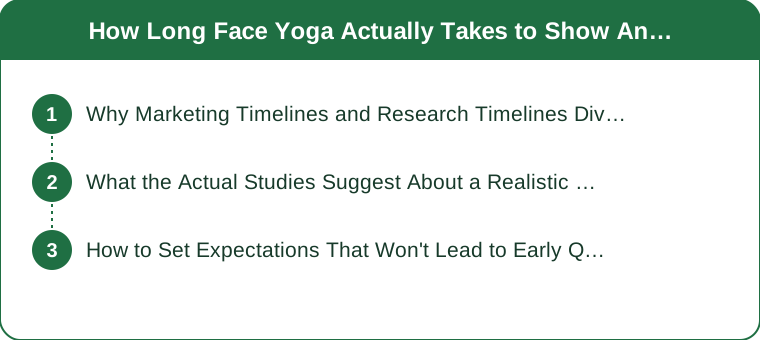
Why Do Marketing Claims and Research Say Such Different Things?
Speed sells, and evidence doesn’t. Commercial face yoga content has a direct financial incentive to promise fast visible results, and essentially no incentive to mention the timeline the research actually used. “Visible lift in 14 days” converts. “Possible modest change after four months of daily practice, evidence limited” does not.
The studies that exist run for months. The small number of controlled trials on facial exercise typically measure outcomes after weeks to months of consistent practice. That’s the actual timeline anyone has bothered to measure.
And there’s a mechanical reason for that. The entire premise of facial exercise is muscle adaptation. Muscle tissue anywhere in the body needs weeks of repeated stimulus before visible change occurs — that’s true of your quads, your biceps, and your zygomaticus. There is no known mechanism by which facial muscles would adapt on a three-day schedule while every other muscle takes months.
So when the honest timeline is weeks-to-months and the advertised timeline is days, quitting at week two isn’t impatience. It’s doing exactly what the marketing implied.

What Timeline Do the Studies Actually Support?
Roughly 8 to 20 weeks. That’s the range the limited controlled research has generally run before measuring outcomes. It’s not a promise of results at week 20 — it’s the window within which anyone has looked.
Consistency inside that window matters as much as the window’s length. The studies involved fairly regular practice throughout. Practicing four times in week one, twice in week three, and not at all in week five doesn’t give you a 20-week trial; it gives you about six weeks of practice spread thin across five months. Realistic minimum: 5–10 minutes daily, or close to it.
Hold all of this with modest confidence. This is the part most articles skip. The research base on facial exercise is small in quantity and limited in quality — small sample sizes, short durations, few controls, and outcome measures that often depend on subjective assessment. The 8-to-20-week figure is the best available rough estimate, not an established fact. It’s entirely reasonable to do this for four months and see nothing.
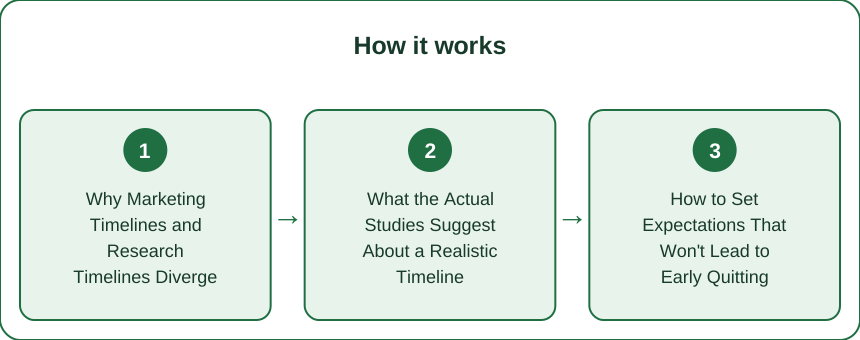
What Nobody Tells You About Judging Your Own Results
Your mirror is the worst measurement tool you own. You see your face daily. Gradual change across 12 weeks is precisely the kind of change daily observation cannot detect — the same reason you don’t notice your own hair growing. People routinely conclude “nothing happened” while a side-by-side photo shows otherwise, and equally often conclude “it’s working!” from a day when they slept well and the light was flattering.
Photograph under controlled conditions or don’t bother. Same spot, same time of day, same light source, same neutral expression, same distance. Once every two weeks. Different lighting alone can manufacture or erase an apparent result entirely — which is, not coincidentally, how a lot of before-and-after marketing photos work.
Morning face isn’t your face. Facial puffiness varies enormously with sleep, salt, alcohol, and time since waking. Shooting a “before” at 8am and an “after” at 6pm compares two different states of hydration, not two states of muscle tone.
Commit to the full window before evaluating. Set a date 12 weeks out. Don’t judge before then. Checking weekly for a change the research says shouldn’t be visible yet is the single most reliable way to quit right before the only window where anything might show.
Treat it as one input, not the whole plan. Sun protection, sleep, and a reasonable skincare routine have far stronger evidence behind them than facial exercise does. Face yoga sitting alongside those is a sensible experiment. Face yoga instead of those is a bad trade.
Mini FAQ
How often do I need to practice for the timeline to apply?
Most study protocols used daily or near-daily practice, typically in the 5–20 minute range per session. A few times a week likely extends any realistic timeline well past 20 weeks — if it produces anything at all.
Can face yoga make things worse?
Aggressive pulling and tugging on facial skin is worth avoiding, and repetitive strong expressions could in principle reinforce expression lines rather than soften them. Keep pressure gentle. If a movement hurts, stop doing it.
When should I talk to a professional instead?
If your actual concern is something specific — significant volume loss, deep static lines, skin laxity after major weight change — a dermatologist can tell you in one visit whether facial exercise is even addressing the right mechanism. And any new facial asymmetry, drooping on one side, or muscle weakness needs prompt medical evaluation; that’s not a face yoga question at all. This is general information, not medical advice.
TL;DR:
- Research timeline is roughly 8–20 weeks of consistent practice; marketing’s “days” claim has nothing behind it.
- Muscle adaptation takes weeks anywhere in the body — the face isn’t exempt.
- Evidence base is small and methodologically limited; hold the estimate loosely, and accept it may do nothing.
- Judge with fixed-condition photos every two weeks, never with the daily mirror.
- Commit to a full 12-week window before evaluating, and keep sun protection and sleep as the foundation.
Keep Reading
This article is for general informational and styling purposes only. Fit, sizing, and product availability may vary.