The Face Yoga Studio: Fitness From the Neck Up
Quick Answer: Face yoga has one encouraging small study — 20 weeks of daily facial exercise produced fuller-looking cheeks and a younger dermatologist-rated appearance. Facial muscles can modestly hypertrophy, which adds volume. What it can’t do is tighten loose skin, which is collagen’s department. Five to ten minutes daily, and the relaxation half is the most reliable benefit.
Face yoga makes an enormous claim — natural facelift! — and it owns exactly one genuinely interesting study.
That’s a worse ratio than the marketing suggests and a better one than the skeptics assume. Faces do have muscles. Muscles do respond to training. And tension absolutely shows on a face.
So here’s the honest version: what’s real, what’s hopeful, and what’s actually just about relaxing — which turns out to be the part worth doing.

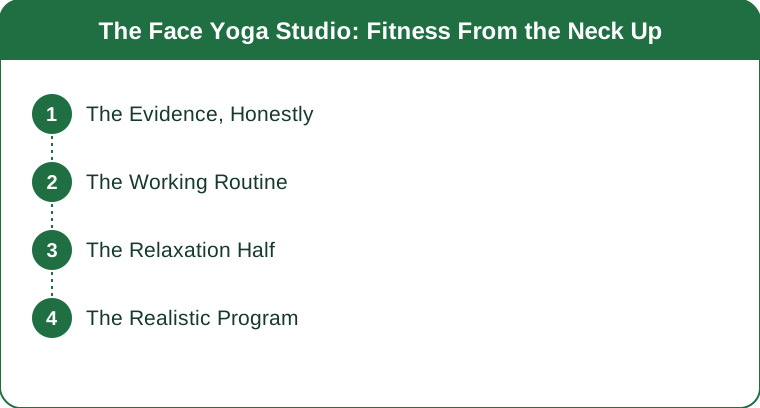
What Does the Research Actually Say?
The famous study: researchers at Northwestern ran a 20-week facial exercise program — 30 minutes daily for the first eight weeks, then every other day — and found measurably fuller-looking upper and lower cheeks, with dermatologists rating participants as looking younger by roughly three years on a standardized scale.
That’s a real result in a real journal. It’s also a small study without a control group, which means it’s encouraging rather than conclusive. Anyone citing it as proof of a natural facelift is skipping past the study’s own caveats.
The mechanism is plausible, which matters. Facial muscles can hypertrophy modestly like any other muscle, and a fuller muscle sitting under the skin reads visually as volume — which is precisely what aging faces lose. The logic holds together.
The honest limits are equally important:
- No exercise tightens loose skin. Skin laxity is a collagen and elastin issue, which is the retinoid-and-SPF conversation, not the muscle one. Working the muscle underneath doesn’t shrink the covering.
- The time commitment in the study was substantial. Thirty minutes a day for eight weeks is a serious ask, and shorter routines haven’t been tested to the same standard.
- “Yoga face-lift” massively oversells what “modest volume and tone changes with serious consistency” actually delivers.
The Working Routine
Five to ten minutes daily. The consistency bar is the real barrier — this is a habit problem, not a technique problem.
1. The cheek lifter — the studied movement. Open your mouth into an O shape, fold your upper lip over your teeth, then smile to lift your cheek muscles. Place fingers lightly on the top of your cheeks, release, and repeat. 20 repetitions.
2. The forehead smoother. Place both palms flat on your forehead, fingers spread, and try to raise your eyebrows against the resistance of your hands. You’re training the muscle without creasing the skin. Hold 30 seconds, 3 times.
3. The jaw and neck series. Tilt your head back, look at the ceiling, and push your lower jaw forward until you feel a stretch along the front of your neck. Posture’s forgotten territory, and the area people most often ignore. Hold 10 seconds, 5 times.
4. The eye-area gentleness rule. The skin here is tissue paper. Aggressive tugging costs more in irritation and mechanical stress than any toning gains. Whatever you do here, do it lightly, and never drag the skin.
Gym rules apply at face scale: clean hands, moisturized skin so nothing drags, and a mirror for form. Don’t do these with dry skin and dirty fingers — you’ll trade a theoretical benefit for actual breakouts.

What Nobody Tells You: The Relaxation Half Is the Better Half
Here’s the part that gets skipped, and it’s the part with the most reliable payoff.
A great deal of what ages a face day to day is tension. The clenched jaw — the masseter is one of the most overworked muscles many people own, and the TMJ-and-stress connection is well established. The furrowed concentration brow. The screen squint that’s been going since 9 a.m.
Face yoga’s release work directly addresses what strengthening can’t:
- The jaw unclench. Let your teeth part, tongue rest on the roof of your mouth, and notice how much you were holding. Most people are genuinely startled by this the first time.
- Temple and masseter massage. Small circles, moderate pressure, 30 seconds each side.
- Deliberate brow softening, several times a day, ideally with a phone reminder.
- The eye-strain break — look at something 20 feet away for 20 seconds, every 20 minutes.
The overlap with the gua sha and facial massage world is total here: circulation, gentle lymphatic movement and tension release are the shared, plausible core of all of it.
Relaxed reads younger than lifted — and unlike the muscle-building half, relaxed is available today, for free, in about ninety seconds.
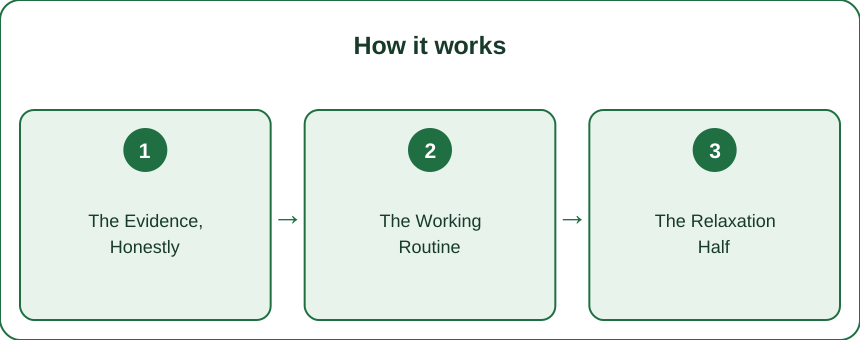
Where Does Face Yoga Fit in a Real Routine?
Ordered by evidence, strongest first:
- Daily SPF. The undefeated anti-ager, not close, not arguable.
- Retinoids. The most studied topical ingredient tier by a wide margin.
- Sleep and not smoking. The boring giants nobody wants to hear about.
- Then face yoga — the plausible bonus round.
Framed that way, it’s genuinely worth five minutes: free, pleasant, possibly volumizing, definitely de-tensing. What it isn’t is a substitute for anything above it on that list, or a competitor to clinical procedures.
The framing that survives scrutiny: face yoga is facial self-care with plausible benefits, not surgery’s rival. The unclenched jaw alone justifies the five minutes, and that’s a perfectly good reason to do something.
If it helps, treat it the way you’d treat a short mobility session — a small daily ritual you do in whatever you’re already comfortable in, rather than an event requiring preparation. The routines that survive are the ones with no setup cost.
When to see a professional: see a dermatologist rather than starting a facial exercise routine if you have persistent skin irritation, a new or changing lesion, or specific concerns about skin laxity — the effective treatments for laxity are different from anything described here. See a dentist or doctor for jaw pain, clicking, locking or persistent headaches, which can indicate a TMJ disorder needing proper assessment. And stop any movement that causes pain rather than working through it; this is one area where enthusiasm genuinely doesn’t help.
FAQ
Does face yoga actually work?
Partially, and modestly. The available evidence supports small improvements in facial fullness and appearance with substantial, consistent practice over months. It does not tighten loose skin, and the “natural facelift” framing overstates what the research shows.
How long does face yoga take to show results?
The study that found positive results ran for 20 weeks with daily practice at the start. Expect a timeline in months rather than weeks, and realistically expect subtle changes rather than dramatic ones. The tension-release benefits, by contrast, are immediate.
Can face yoga cause wrinkles?
Repeated strong creasing of the skin is a reasonable theoretical concern, which is why well-designed exercises use hands to resist and stabilize rather than letting the skin fold — the forehead smoother is the clearest example. Avoid movements that visibly crease the same line repeatedly, and go gently around the eyes.
TL;DR
- One encouraging small study, 20 weeks, fuller cheeks and a younger rating. Real, not conclusive.
- Muscles can add volume. Nothing here tightens loose skin — that’s collagen’s department.
- 5-10 minutes daily: cheek lifter, resisted forehead smoother, jaw and neck series. Gentle around the eyes.
- The relaxation half is the more reliable benefit. Unclench the jaw, soften the brow, massage the masseter.
- SPF > retinoids > sleep > face yoga. It’s the bonus round, not the foundation.
- Jaw pain, clicking or headaches means see a dentist or doctor, not do more exercises.
Keep Reading
This article is for general informational and styling purposes only. Fit, sizing, and product availability may vary.