Why Face Yoga Results Often Look Different on the Left Side vs. the Right
Quick Answer: Most faces have natural baseline asymmetry in muscle strength and bone structure before any face yoga practice begins, so a more defined result on one side often reflects that pre-existing asymmetry becoming more visible as muscle tone improves overall, rather than the exercises working unevenly.
It’s a common and understandably frustrating observation, but asymmetric-looking results are actually one of the more predictable outcomes of a practice that’s working as intended on a face that, like nearly everyone’s, wasn’t perfectly symmetrical to begin with.

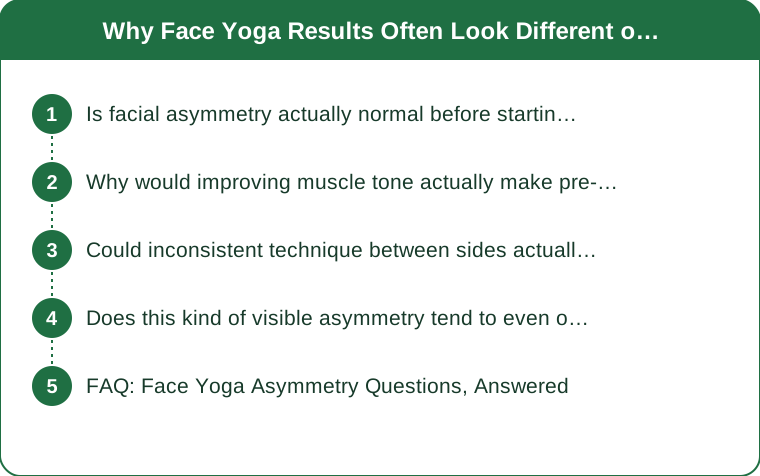
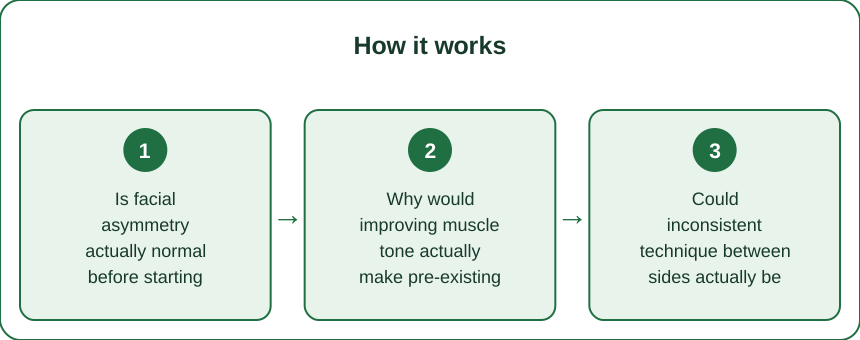
Is facial asymmetry actually normal before starting any face yoga practice?
Yes, genuinely near-universal — very few faces are perfectly symmetrical, and differences in muscle strength, bone structure, and even habitual expression patterns (favoring chewing on one side, sleeping consistently on one side) between the left and right side are extremely common and present long before any targeted facial exercise practice begins.
Why would improving muscle tone actually make pre-existing asymmetry more visible rather than less?
As facial muscles on both sides develop more tone and definition, any underlying difference in starting strength or bone structure becomes proportionally more visible, similar to how strength training elsewhere on the body can reveal pre-existing muscle imbalances that weren’t obvious when both sides were simply less developed — this is a normal and expected pattern, not a sign the practice is failing.

Could inconsistent technique between sides actually be contributing to this too?
It’s possible and worth checking — many people unconsciously favor their dominant side (dominant-hand pressure during exercises using fingers, or naturally stronger engagement on one side due to habitual chewing or expression patterns) which can produce a small technique-driven difference on top of any natural asymmetry, so consciously checking effort and pressure evenness between sides is a reasonable troubleshooting step.
Does this kind of visible asymmetry tend to even out over more time, or stay consistent?
For asymmetry driven mainly by pre-existing structural differences, it typically persists at some level rather than fully resolving, since face yoga tones muscle rather than altering underlying bone structure — but for asymmetry partly driven by uneven habitual use or technique, more consistent, deliberate effort on the less-developed side over time can narrow (though rarely fully eliminate) the visible gap.
FAQ: Face Yoga Asymmetry Questions, Answered
Should I do extra reps on the less-developed side to try to catch it up?
Some practitioners do add slightly more focused reps on the less-developed side, and this is generally considered a reasonable, low-risk approach — though full symmetry usually isn’t fully achievable given underlying structural asymmetry.
Is visible facial asymmetry a sign of an underlying health issue that needs medical attention?
Mild, longstanding, symmetric-with-practice asymmetry present since before starting is generally not a medical concern — asymmetry that’s new, sudden, or accompanied by other symptoms (weakness, drooping, numbness) is different and warrants a prompt medical evaluation rather than being attributed to face yoga.
Does professional massage or a facialist evaluation help identify whether the asymmetry is muscular or structural?
A facialist or physical therapist experienced in facial muscle work can often help distinguish muscular tension or imbalance from underlying bone structure, which can clarify realistic expectations for how much a consistent face yoga practice might narrow the visible gap.
TL;DR:
- Facial asymmetry is normal and near-universal before any face yoga practice begins
- Improving overall muscle tone often makes pre-existing asymmetry more visible, not less
- Uneven technique or pressure between sides can add a small additional effect worth checking
- Structural asymmetry tends to persist; habit-driven asymmetry can narrow with deliberate effort
This is general information, not medical advice — sudden or new asymmetry with other symptoms should be evaluated by a doctor.
Keep Reading
This article is for general informational and styling purposes only. Fit, sizing, and product availability may vary.