Why Do Face Yoga Results Look So Different on Different Face Shapes?
Quick Answer: Underlying bone structure, existing muscle tone, skin elasticity, and fat distribution all vary significantly between faces, and face yoga primarily affects muscle tone — meaning it changes different faces to different visible degrees depending on how much of a given result was ever going to come from muscle versus bone or fat.
Two people can follow an identical face yoga routine with equal consistency and see meaningfully different results, which understandably reads as one of them “doing it wrong” — but the more likely explanation is structural, not technique-based.

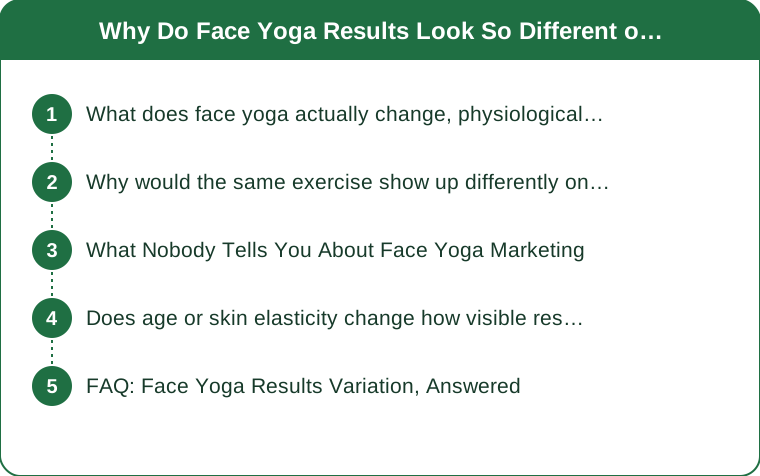
What does face yoga actually change, physiologically?
Face yoga exercises primarily target facial muscle tone and, to a lesser degree, circulation and lymphatic flow — they don’t alter bone structure, and their effect on skin elasticity itself is limited compared to their effect on the muscle beneath it. This means results are naturally more visible on faces where muscle tone was the primary factor behind a specific area of concern, and less visible where bone structure or fat distribution plays the bigger role.
Why would the same exercise show up differently on two faces?
Consider jawline definition specifically: on a face where a stronger, straighter jaw bone structure already exists, toning the muscle along that bone tends to create a more visible definition change. On a face with a naturally softer or more rounded bone structure, the same muscle toning happens but the visible outcome is subtler, because bone shape — not muscle tone — is doing more of the visual work in that particular area.

What Nobody Tells You About Face Yoga Marketing
Most face yoga before-and-after photos come from a specific subset of face shapes and starting points that show dramatic visual change — which creates unrealistic expectations for people whose face structure means the same routine will produce a real but much subtler result. This isn’t a sign the exercises “don’t work” for those faces — it’s a mismatch between marketing and structural reality.
Does age or skin elasticity change how visible results are?
Yes, meaningfully — skin with more remaining natural elasticity shows the effects of underlying muscle toning more clearly, since the skin can “catch” the new muscle contour, while skin with reduced elasticity shows the same muscle change less visibly, since the skin itself doesn’t tighten to reveal it as clearly.
FAQ: Face Yoga Results Variation, Answered
Does this mean face yoga just doesn’t work for some people?
Not exactly — the underlying muscle toning still occurs, but how visible that toning is depends on bone structure, fat distribution, and skin elasticity, which vary independently of how correctly or consistently someone practices.
Is there a way to know in advance how visible my results might be?
Not precisely, but people with more visible existing muscle definition after mild intentional tensing (a simple self-check) tend to see face yoga’s effects more clearly than people whose face shape is driven more by bone or fat distribution.
Should someone with less visible results just do more repetitions?
More isn’t necessarily better — overdoing facial exercises has been associated by some practitioners with premature fine lines from repetitive movement, so consistency at a moderate level is generally recommended over increasing volume to chase results structural factors may limit anyway.
TL;DR:
- Face yoga primarily changes muscle tone, not bone structure or fat distribution
- The same routine shows more visible results on faces where muscle was the main factor in an area
- Marketing photos often reflect faces predisposed to dramatic visible change, skewing expectations
- Skin elasticity affects how visibly muscle toning translates to appearance
Different results from the same routine usually reflect different starting structure, not different effort or technique.
Keep Reading
This article is for general informational and styling purposes only. Fit, sizing, and product availability may vary.