Why Face Yoga Can Give You a Headache and How to Fix It
Quick Answer: Face yoga headaches almost always come from recruiting the wrong muscles - specifically bracing the jaw, the temples, or the back of the neck while trying to work the face. The four usual causes are clenching during holds, holding your breath, overworking the frontalis on forehead moves, and doing it with your neck craned toward a mirror. All four are fixable in a session. If a headache is severe, sudden, or comes with visual changes, stop and get it checked.
It is a genuinely common complaint and it is almost never a reason to abandon the practice. The face has a dense network of small muscles that share space with some of the most reliable headache generators in the body, and the difference between working one and triggering the other is mostly technique.

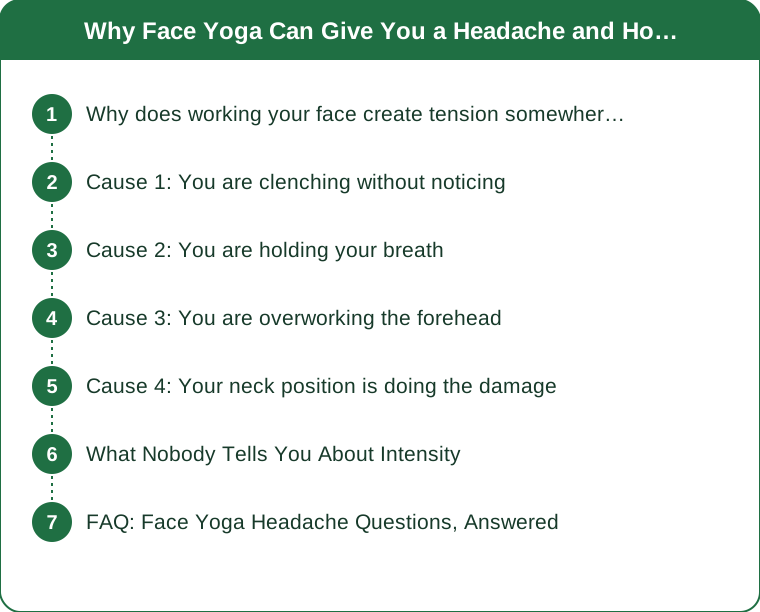
Why does working your face create tension somewhere else?
Because facial muscles are small and weak, and your body compensates by recruiting bigger neighbours.
The muscles of facial expression are thin and attach to skin rather than to bone at one end. They are not built for load. When you ask one to work harder than it can - by holding a strong contraction, or repeating past fatigue - the nervous system does what it does everywhere else in the body and recruits synergists: nearby muscles that can help.
Around the face, those neighbours are the temporalis (the fan-shaped muscle over your temple that closes your jaw), the masseter (the thick one at the angle of the jaw), and the suboccipitals at the base of the skull. All three are extremely well documented sources of tension-type headache.
So the sequence is: face muscle fatigues, jaw and temple muscles take over, those muscles are not supposed to be working, they get sore, and you feel it as a band around the head or an ache behind the eyes.
The tell: if you can feel your back teeth touching during a face yoga move, that is the mechanism happening in real time.
Cause 1: You are clenching without noticing
This is by far the most common, and it is almost always unconscious.
Clenching during effort is a deeply wired reflex. People clench when lifting, when concentrating, and when doing anything unfamiliar that requires focus. Face yoga combines effort with concentration in the region where clenching lives, which makes it a perfect storm.
The temporalis is a large muscle for its job and it fatigues into ache rather than into obvious pain, so you can clench through an entire ten-minute session without registering it.
The fix, and it works immediately: put your tongue on the roof of your mouth, just behind the front teeth, and keep a 2-3mm gap between your back teeth throughout the session. This position makes clenching mechanically awkward and it is easy to check.
Second checkpoint: every 30 seconds, notice your jaw. If it has closed, open slightly and continue. Most people need this reminder for the first two weeks and then stop needing it.
Cause 2: You are holding your breath
The second most common, and it produces a distinctly different headache - more pressure than ache, often behind the eyes or across the forehead.
Breath holding during exertion is another wired reflex, and holding a facial contraction for 10 or 20 seconds is exactly the kind of effort that triggers it. Holding your breath while straining raises intrathoracic pressure and briefly raises intracranial pressure, and the pressure headache follows.
The fix: count out loud, or hum. Both make breath holding impossible. Counting is the simpler option and it doubles as your timer.
If humming feels odd, exhale slowly through the mouth for the whole hold. A slow controlled exhale also drops overall muscle tone slightly, which helps with the clenching problem at the same time.
One useful sign: if you finish a hold with a sudden involuntary breath in, you were holding it.

Cause 3: You are overworking the forehead
Forehead and eye-area moves are where technique errors concentrate, and the frontalis is a muscle that punishes overuse quickly.
The frontalis raises your eyebrows. It is thin, broad, and it sits directly over one of the more sensitive areas for tension headache. Repeated strong contraction of it - which is what happens when people do brow-lifting exercises enthusiastically - produces a band of ache across the forehead within a day.
There is a related and equally common error: using the forehead to do an eye exercise. Most eye-area moves are supposed to work the orbicularis oculi, the ring muscle around the eye. If your eyebrows lift while you do them, the frontalis has taken over and you are getting the headache without the intended benefit.
The fix: place two fingers flat on your forehead as a stabiliser and a monitor during any eye-area work. If the forehead moves under your fingers, reduce the effort until it stops. This single adjustment resolves a large share of face yoga headaches on its own.
And reduce the volume. Forehead work needs far fewer reps than people assume - 5-8 controlled repetitions is plenty, not 20.
Cause 4: Your neck position is doing the damage
This one has nothing to do with your face and everything to do with where you are looking.
Most people do face yoga in front of a mirror, and most bathroom mirrors are positioned so that you end up craning slightly - chin forward, neck extended, shoulders up. Hold that for ten minutes and the suboccipital muscles at the base of the skull go into spasm, which produces a classic referred headache felt behind the eye or over the crown.
The giveaway is where it hurts and when it starts. Suboccipital referral is usually one-sided, arrives an hour or two after the session, and comes with a stiff neck.
The fix is position. Sit down. Bring the mirror to eye level, or use a handheld one, or skip the mirror entirely for the moves you already know. Shoulders down and back, chin gently tucked, ears over shoulders.
If you have been doing it standing over a bathroom sink, changing to sitting at a table with a propped mirror often eliminates the headache completely and immediately.
What Nobody Tells You About Intensity
Face yoga is one of the few forms of exercise where more effort is straightforwardly worse, and almost nothing in the popular instruction says so.
The muscles you are working are tiny. Some of them weigh a fraction of a gram. Applying the intensity mindset from strength training - push hard, feel the burn, go to failure - is not just unnecessary here, it is the direct cause of most of the problems people report.
The right intensity for a facial contraction is about 50-60% of maximum. Enough to clearly feel the target muscle engage, not enough to recruit anything else. If you are making an obvious strain face, you are past it.
Frequency beats intensity, substantially. Short sessions of 5-10 minutes, most days produce better results than a hard 25-minute session twice a week, and produce almost no headaches.
And the counterintuitive one: soreness is not a goal here. In the rest of your training, some soreness signals adaptation. In facial muscles, soreness usually signals that a neighbouring muscle took the load.
FAQ: Face Yoga Headache Questions, Answered
How long should a headache from this last?
A technique-related one typically fades within a few hours and does not return once you fix the cause. Something that lasts more than a day or recurs after every session despite corrections is worth investigating rather than working around.
Should I stop the practice entirely?
No - change one variable at a time. Start with jaw position and breathing, since between them they explain most cases. Give it three sessions before changing anything else.
Can face yoga make TMJ problems worse?
It can, if you clench through it or do heavy jaw-focused work. If you have a diagnosed jaw joint issue, get specific guidance before doing jaw or mouth-area exercises - the rest of the practice is usually fine.
This is general information, not medical advice. A headache that is sudden and severe, the worst you have had, or accompanied by visual changes, weakness, or confusion needs urgent medical attention rather than a technique adjustment.
TL;DR:
- Face yoga headaches come from recruiting the jaw, temple, or neck muscles to help small facial muscles.
- Tongue on the roof of the mouth, teeth apart stops the clenching that causes most of them.
- Count out loud so you cannot hold your breath, and stabilise the forehead with two fingers on eye work.
- Sit down with the mirror at eye level - craning over a bathroom sink is a bigger culprit than the exercises.
- Work at about 50-60% effort. This is the rare practice where trying harder makes it worse.
Fix the jaw and the breathing first and most people find the headaches simply stop. The practice was never the problem - the bracing around it was.
Keep Reading
This article is for general informational and styling purposes only. Fit, sizing, and product availability may vary.