The Facial Muscles You Are Already Training All Day Without Meaning To
Quick Answer: Some facial muscles get hundreds of unintentional contractions a day and need releasing, not strengthening. The corrugator (between the brows), masseter (jaw) and orbicularis oculi (around the eyes) are chronically overworked in anyone who uses screens; the mid-face and neck are usually underworked. Doing strengthening exercises for already-tense muscles is the most common way face yoga backfires.
Face yoga routines tend to treat the face as uniformly under-trained, which is a strange assumption for a body part you use continuously while awake.
Some of it is genuinely under-used. Some of it is doing hundreds of unplanned reps a day, and adding more is the opposite of what it needs.

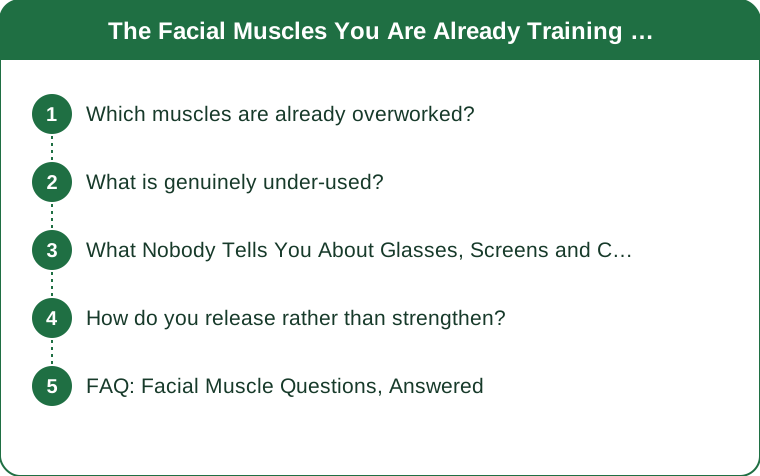
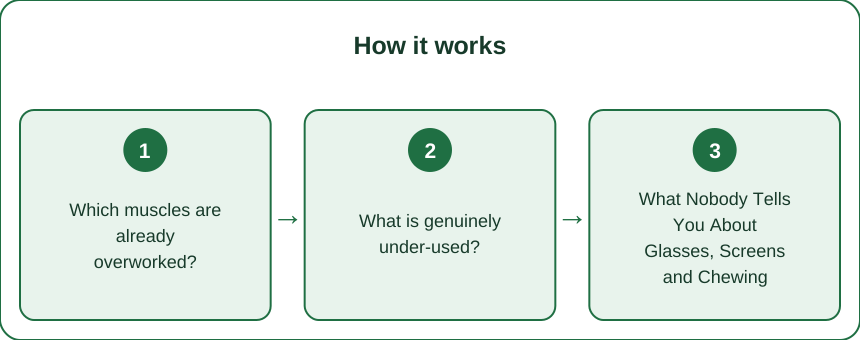
Which muscles are already overworked?
Three, reliably, in anyone who spends the day looking at a screen.
The corrugator supercilii, between and just above the eyebrows, pulls the brows together and down. It fires during concentration, squinting, and any effort at all. If you focus on something mildly difficult, it contracts. Over a working day this is an enormous number of low-level contractions, and it is why so many people carry a permanent slight furrow and describe tension in exactly that spot.
The masseter, at the jaw angle, is the strongest muscle in the body by cross-sectional force. It contracts during chewing, during clenching, and during concentration or stress in people who clench without noticing. Night clenching adds hours more. A masseter that is already hypertrophied from clenching does not need jaw-strengthening exercises, and doing them can worsen both the tension and the squared appearance people are often trying to soften.
The orbicularis oculi, the ring around the eye, contracts every time you squint. Screen glare, small text, bright light, and — importantly — an outdated glasses prescription all produce continuous low-level squinting.
What these three have in common is that they are tension muscles, not weakness muscles. The appropriate intervention is release: warmth, gentle massage, and above all removing the cause. Strengthening them is adding reps to a muscle already doing overtime.
What is genuinely under-used?
The mid-face, the neck front, and parts of the mouth ring — and these are where face yoga has its most plausible case.
The zygomaticus muscles, running from the cheekbone to the corner of the mouth, are the main lifters of the mid-face. They fire during genuine smiling and relatively little otherwise. A day of neutral screen-facing expression involves very little zygomatic activity.
The platysma, the broad sheet down the front of the neck, is barely used in ordinary life and is the muscle most implicated in the appearance of the neck and jawline junction. It is also directly opposed by forward head posture, which shortens the front of the neck — meaning a screen-heavy day both under-uses it and places it in a shortened position.
The orbicularis oris, around the mouth, gets moderate use from speaking and eating and much less from the specific range of motion that face yoga targets.
The honest framing is that the evidence base for facial exercise producing appearance change is thin but not empty — there is a small body of research suggesting modest improvement in mid-face fullness after several months of consistent daily practice. The effect sizes are small and the studies are small. What is much better established is that facial massage and tension release produce a real, immediate change in how the face feels and looks, which is a different claim and a more reliable one.
So the practical split: release the overworked three, and if you want to train something, train the mid-face and neck.

What Nobody Tells You About Glasses, Screens and Chewing
Three everyday habits do more to your facial muscles than any routine, and they are invisible because they are constant.
An outdated prescription is a squinting machine. If your glasses or contacts are even slightly under-corrected, you squint continuously without registering it, which means thousands of daily contractions of the orbicularis oculi and often the corrugator too. People who get an updated prescription frequently report that a long-standing brow tension simply disappears. If you are doing eye-area face yoga and have not had your eyes tested in two years, the eye test is the higher-value intervention by a wide margin.
Screen distance and text size drive the same mechanism. Text that is slightly too small produces continuous micro-squinting. Increasing system font size by two steps is free and works immediately. Screen glare does the same thing — a window behind the monitor is a squint source all day.
One-sided chewing builds one-sided muscle. Most people have a dominant chewing side, often driven by an old dental issue. Over years this produces measurably different masseter development left and right, and it is one of the more common explanations for facial asymmetry that people attribute to sleeping position. Chewing gum aggressively — particularly on one side — is effectively masseter hypertrophy training, which is the opposite of what most people want.
Phone posture stacks with all of it. Looking down at a phone shortens the front of the neck and slackens the platysma, and does it for hours. The muscle is not weak from lack of exercise so much as from being held short.
The order that actually makes sense: fix the prescription, fix the text size and glare, notice the chewing side, raise the phone. Then consider exercises.
How do you release rather than strengthen?
Gently, briefly, and more often than intensely. Release work responds to frequency.
Brow and corrugator. Place two fingers on each brow and sweep outward with light pressure, 10 slow passes. Then place a fingertip on the point between the brows and hold steady pressure for 20 to 30 seconds while consciously letting the brow drop. The conscious release is the active ingredient — the pressure is a cue.
Masseter. Find the muscle by clenching once and feeling the bulge at the jaw angle, then unclench. Massage in small circles with moderate pressure for 30 to 60 seconds per side. Warmth helps considerably. Follow with a passive jaw drop: let the mouth fall open with zero effort and hold for 30 seconds, tongue resting on the floor of the mouth.
Eye area. Close the eyes and rest the palms lightly over them, no pressure on the eyeball, for 60 seconds. Then look far away — genuinely far, out a window — for 20 seconds. The distance focus releases the ciliary muscle and reduces the squint reflex.
Frequency over intensity. Three brief releases spread through a day beat one long session, because you are interrupting accumulated tension rather than treating it after the fact.
The check that tells you if it worked: notice your resting face at random moments. Set a couple of daily reminders that just say jaw. Most people discover they are clenching at moments they would have described as relaxed, and that noticing alone changes the pattern over a few weeks.
A seasonal note: as light levels drop through autumn and screens get used in darker rooms, squint-driven tension tends to increase. Raising ambient light around the screen is worth doing before assuming the tension is stress.
FAQ: Facial Muscle Questions, Answered
Does that mean face yoga is pointless?
No — it means half of a typical routine is aimed at the wrong muscles. Mid-face and neck work is reasonable. Brow, jaw and eye strengthening for someone who already carries tension there is at best redundant.
How do I know if I clench at night?
Common signs are jaw soreness or tightness on waking, headaches at the temples in the morning, tooth sensitivity, and scalloped edges on the tongue. A dentist can usually confirm from wear patterns. This is worth raising with them rather than self-treating, since a night guard is the standard answer and it works.
Can facial massage cause sagging?
Aggressive downward dragging on unsupported skin is not advisable, particularly around the eye where the skin is thinnest. Light pressure, upward and outward direction, and slip from a facial oil or moisturiser rather than dry friction — those cover the reasonable precautions.
Why is one side of my face more tense?
Chewing side dominance, sleeping position, and phone-holding side are the three usual candidates, and chewing is the most underrated. Notice which side you chew on for a few meals; most people are surprised.
How long before released tension stays released?
The immediate release lasts hours at first. Making it durable requires removing the driver — prescription, screen setup, clenching habit — because the muscle will simply retighten while the cause is running.
This is general information, not medical advice. Persistent jaw pain, clicking, or restricted opening should be assessed by a dentist or doctor.
TL;DR:
- The corrugator, masseter and orbicularis oculi are chronically overworked by screens, squinting and clenching — release them, do not train them.
- The mid-face and front of the neck are genuinely under-used and are the more defensible targets for exercise.
- An outdated glasses prescription is one of the biggest hidden sources of facial tension.
- One-sided chewing builds one-sided muscle and explains a lot of perceived asymmetry.
- Release responds to frequency: three short sessions a day beat one long one.
Before adding reps to your face, work out which muscles have already been doing reps all day. For most people that changes the routine substantially.
Keep Reading
This article is for general informational and styling purposes only. Fit, sizing, and product availability may vary.