Morning or Evening Face Yoga? When Each Actually Works Better
Quick Answer: Both times work, but for different reasons. Morning face yoga excels at moving overnight fluid - the puffiness you wake up with responds to gentle massage and lymph-directed strokes within minutes, giving a visible same-day payoff. Evening practice excels at releasing accumulated tension - the clenched jaw, gathered brow, and screen-set neck of a full day respond best when you can actually feel what needs releasing. If you only have five minutes, spend it at the time whose problem you actually have: puffy mornings or tight evenings. Consistency at either hour beats perfection at the theoretical best one.
Every guide assumes you will practice at one golden hour, usually whichever one the author prefers. The truthful answer is more useful: morning and evening sessions are doing two different jobs, and knowing which job you need is the entire decision.

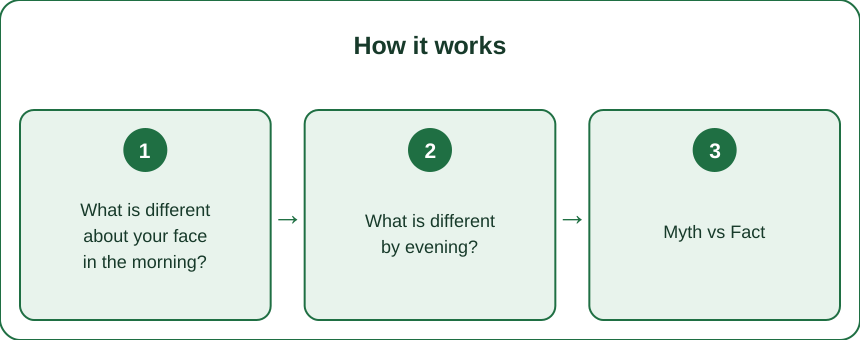
What is different about your face in the morning?
It is a fluid story, and it explains both the puffiness and the opportunity.
Overnight, gravity stops helping. Lying flat for seven hours lets interstitial fluid distribute evenly instead of draining downward, and the face - full of loose, expressive tissue with room to swell - shows it more than anywhere else. Add a salty dinner, a warm bedroom in a humid August, a glass of wine, or side-sleeping pressed into a pillow, and you get the familiar morning face: puffier eyelids, softer jawline, creases from the pillowcase.
This fluid is exactly what responds to morning practice. Lymphatic drainage is a slow, passive system that responds to gentle mechanical encouragement - light strokes directed from the center of the face outward and down toward the collarbone, gentle pumping at the sides of the neck first to open the pathway. Five minutes of this visibly shifts morning puffiness for most people, which makes morning the honest quick-win session: you can see the before and after in one mirror visit.
Muscles, meanwhile, are at their daily baseline. You have not yet spent hours squinting, clenching, or holding your brow at attention, so morning is less about releasing tension - there is not much yet to release - and more about drainage plus gently waking the lifting muscles of the cheeks with a few active exercises.
The practical morning sequence, five minutes flat: thirty seconds of neck-side pumping, two minutes of outward-and-downward strokes across the eye area, cheeks, and jawline, then two minutes of active work - cheek lifts, a few rounds of wide-then-soft eyes - to bring tone into a face that fluid had blurred. Cool hands or a cold spoon on the eyelids first accelerates everything on a hot late-summer morning.
What is different by evening?
By evening the fluid has drained on its own - and been replaced by the day.
Tension is now the material. Ten hours of screen focus sets a specific pattern: brows drawn slightly together and up, jaw held with teeth in light contact or fully clenched, lips pressed, neck craned forward. None of these are movements - they are holds, sustained low-grade contractions, and sustained contraction is what face yoga’s release work is actually for.
Evening is when you can feel what needs work. Press a knuckle gently into the masseter - the thick muscle at the angle of the jaw - at 8am and it is usually quiet. The same press at 8pm after a deadline day finds a tender, ropy muscle that softens noticeably under thirty seconds of slow circles. Self-assessment is simply more accurate in the evening because the day has written its record into the tissue.
Release work also pairs with the wind-down. Slow massage of the jaw, temples, and brow line activates the parasympathetic shift the body wants before sleep anyway - which is why evening face work tends to feel disproportionately good and why it slots so naturally after cleansing, when fingers already glide on residual moisture or a facial oil.
The practical evening sequence, five minutes flat: one minute of slow masseter circles with knuckles, jaw hanging slack; one minute of temple circles and brow-line pinches from center outward; one minute smoothing the forehead upward with alternating palms; one minute of ear-to-collarbone neck strokes; and a final minute of the neck and jaw stretch - chin tilted up, lower lip over top, held gently.
What evening is not for: vigorous drainage work. There is less fluid to move, and stimulating circulation aggressively right before bed suits some people poorly. Evening favors slow, warm, downward-tempo work - release, not activation.

Myth vs Fact: Face Yoga Timing
Myth: Morning practice is the only one that gives visible results. Fact: Morning gives the fastest visible result - depuffing shows in minutes - but the cumulative benefits people actually want from face yoga come from the tension-release and muscle-tone work, which evening serves at least as well. Fast feedback and real progress are different things.
Myth: Face yoga at night interferes with sleep. Fact: Slow release work is a wind-down aid, not a stimulant - it is the facial equivalent of gentle stretching before bed. The only evening-unfriendly version is vigorous, fast-tempo active exercise, which is easy to simply not do at 10pm.
Myth: You must practice twice a day for it to work at all. Fact: One honest five-minute session most days outperforms two ambitious sessions that stop happening in week two. Twice daily is a nice ceiling for the enthusiastic; it has never been the floor for results.
Myth: More minutes and more pressure equal faster progress. Fact: Facial muscles are small and facial skin is delicate; overworking shows up as irritation, aggravated skin conditions, and soreness rather than accelerated results. Gentle and consistent is not the beginner setting - it is the setting.
Myth: Results should appear within a week. Fact: Depuffing aside, the realistic timeline for changes in tension patterns and muscle tone runs six to twelve weeks of near-daily practice, and the research base overall is modest and early. Anyone promising a transformed face by Friday is selling the wrong week.
How do you choose - and how do you make either stick?
Choose by symptom, anchor by habit.
Pick morning if your complaint is morning-shaped: waking puffy, eyes that take an hour to open properly, a jawline that blurs overnight, photos at 9am you dislike more than photos at 9pm. Your five minutes go where your problem is, and the visible payoff doubles as motivation - a rare treat in any practice.
Pick evening if your complaint is evening-shaped: a jaw that aches by dinner, tension headaches at the temples, the vertical line between the brows deepening, a face that feels held rather than worn. You are a release candidate, and evening is when release works.
Both-shaped? Split the jobs, not the time. Three minutes of drainage in the morning, three minutes of release at night beats six minutes of everything at one end. The jobs are different; let each hour do its own.
Anchor it to something that already happens. Morning practice lives well right after brushing teeth - the mirror is already occupied. Evening practice lives best immediately after cleansing, when slip is on the skin and the bathroom visit is already happening. A practice with an anchor survives busy weeks; a practice that floats does not.
Late-summer specifics, since the season changes the inputs: hot, humid nights and higher sodium from summer eating both push morning puffiness up, so August and September are peak months for the morning session paying off visibly. Keep pressure extra light on sunburned or sun-irritated skin, and evening practice after sun exposure pairs well with the moisturizing step you should be doing anyway.
And the honest closing note: timing optimizes a practice - it does not rescue an absent one. The best time for face yoga remains the time that reliably exists in your day, and every guide that says otherwise is describing its author’s schedule, not your face.
FAQ: Face Yoga Timing Questions, Answered
Is it better to do face yoga in the morning or at night?
Match the session to the symptom: morning practice is best for overnight puffiness, since gentle lymph-directed strokes visibly depuff within minutes, while evening practice is best for releasing the jaw, brow, and neck tension a full day builds. If both apply, split the jobs - brief drainage in the morning, brief release at night.
How long until face yoga shows results?
Depuffing shows the same morning you do it. Changes in tension patterns - a softer jaw, fewer end-of-day headaches - typically take two to four weeks of regular practice, and any changes in visible tone realistically take six to twelve. The evidence base overall is still modest, so patience and consistency are the honest program.
Can face yoga before bed disrupt sleep?
Slow release work does the opposite - jaw and temple massage leans parasympathetic and pairs naturally with a wind-down routine. Save the vigorous, fast-tempo active exercises for daytime sessions and keep evening work slow, warm, and gentle.
Do I need to do face yoga twice a day?
No. One consistent five-minute session most days beats two sporadic ones. Twice daily suits people whose mornings are puffy and whose evenings are tense - three minutes each - but the non-negotiable ingredient is consistency at whatever single time your day reliably offers.
TL;DR:
- Morning face yoga moves overnight fluid - visible depuffing in minutes, the honest quick win.
- Evening face yoga releases the day’s jaw, brow, and neck tension - felt more than seen, and it compounds.
- Choose by your symptom’s shape: puffy mornings or tight evenings. Split the jobs if both.
- Gentle beats vigorous, five minutes beats twenty, and anchored-to-toothbrushing beats floating.
- Real timeline: same-day for fluid, weeks for tension, six to twelve for tone - and August mornings are peak depuff season.
The golden hour was never on the clock. It is wherever your face keeps its complaint, five minutes at a time.
Keep Reading
This article is for general informational and styling purposes only. Fit, sizing, and product availability may vary.