How Long Until Face Yoga Shows — and What Fades First When You Stop
Quick Answer: Published research on facial exercise found measurable changes after roughly 20 weeks of near-daily practice, with participants rated as looking about three years younger on average. The immediate effects you notice in week one - a flushed, slightly fuller look - are circulation and mild swelling, and those fade within days of stopping. Actual muscle changes take months to build and months to lose.
The two timelines get confused constantly, and that confusion is why most people quit at week four.

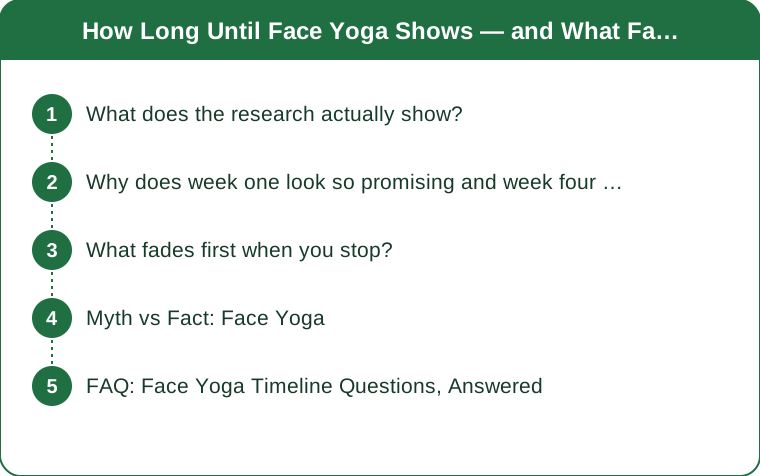
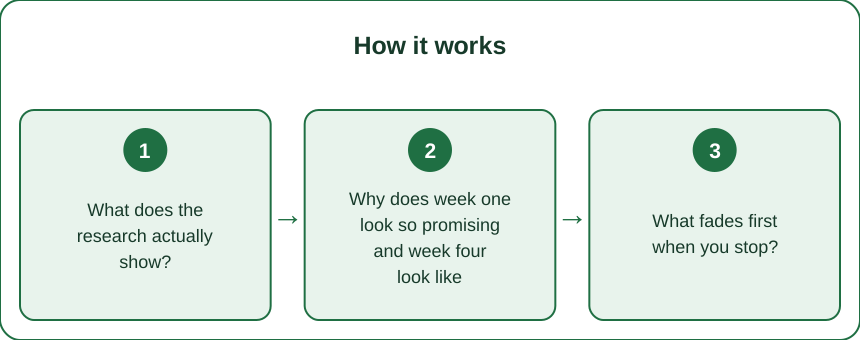
What does the research actually show?
There is less of it than the category’s popularity suggests, but what exists is reasonably encouraging.
The most cited work is a 20-week study in which middle-aged women performed a structured facial exercise program - daily for the first 8 weeks, then every other day. Independent raters assessed before and after photographs and estimated participants’ ages as roughly three years younger at the end. Measured upper and lower cheek fullness increased.
The proposed mechanism is straightforward and plausible: facial muscles are skeletal muscle, they attach partly to skin rather than only to bone, and like other skeletal muscle they can hypertrophy with resistance. Increased muscle volume under the skin restores some of the fullness that is lost with age - since a substantial part of facial aging is volume loss rather than skin laxity alone.
The honest limitations matter:
- Small sample. Around 27 participants, of whom 16 completed. That is a pilot, not a definitive result.
- No control group in the standard sense, and photograph-based rating is subjective even when raters are blinded.
- Very high adherence required. Participants did 30 minutes a day for 8 weeks. That is a serious commitment and a real reason results in the wild are less consistent.
So the fair summary is: plausible mechanism, one promising study, meaningful commitment required, effects that are real but modest. It is not nothing, and it is not the transformation the more enthusiastic videos imply.
Why does week one look so promising and week four look like nothing?
Because two completely different processes are being observed and only one of them is durable.
Weeks 1 to 2 - circulation and transient swelling. Any repeated facial movement, plus the massage and manipulation most routines include, increases local blood flow substantially. You get a flush, a slight plumpness, and a temporarily smoother look. Lymphatic drainage techniques also genuinely reduce morning puffiness, and that effect is immediate.
This looks like fast progress and it is entirely real, but it is a same-day effect. It is present an hour after practice and largely gone by the next morning. This is why the after photo taken right after a session is so much more flattering than one taken the following afternoon.
Weeks 3 to 8 - the flat stretch. The circulation novelty has stopped being noticeable because it is now your normal, and muscle change has not yet accumulated to a visible degree. Nothing appears to be happening. This is when most people stop, and it is the single biggest reason face yoga has a mixed reputation.
Weeks 8 to 20 - actual structural change. Skeletal muscle hypertrophy in response to a novel resistance stimulus generally becomes visible somewhere in the 8 to 12 week range in the body, and facial muscles are small, so the absolute change is small even when the proportional change is not. Around this point, people who kept going start noticing that photographs look different rather than that their face feels different.
Understanding this shape in advance is genuinely the most useful thing you can know before starting. The flat stretch is expected. It is not failure.

What fades first when you stop?
In a predictable order, and the order is useful because it tells you what you were actually getting.
Within 2 to 3 days: the circulation effect. The flush, the slight fullness, the smoother look immediately after practice. This goes almost immediately because it was never a structural change.
Within 1 to 2 weeks: lymphatic and puffiness benefits. If your routine included drainage work, morning puffiness returns to its baseline fairly quickly. This one is worth knowing because puffiness is often the effect people valued most without realising it was the most fragile.
Over 4 to 12 weeks: muscle tone. Detraining in skeletal muscle is slower than people fear. Measurable strength loss in the body generally begins around 2 to 3 weeks of complete inactivity and proceeds gradually. Facial muscles are used constantly in ordinary life - talking, chewing, expression - so they never fully detrain the way an unused body muscle does. The added volume from training does decline, but slowly.
Effectively permanent: none of it. This is worth saying plainly. Facial exercise is maintenance, not a course you complete. The study’s own protocol reduced to every other day rather than stopping, which is a reasonable model.
The practical implication is encouraging rather than discouraging: because muscle detrains slowly and faces get used daily anyway, a maintenance dose is much smaller than a building dose. Missing a week does very little. Dropping from daily to three times a week after five months is likely fine.
Myth vs Fact: Face Yoga
Myth: Face yoga causes wrinkles because you are repeatedly creasing the skin. Fact: This is the most common objection and it deserves a nuanced answer. Repeated creasing does contribute to dynamic wrinkles over time - that is the entire basis of how expression lines form. Which is why well-designed routines use resistance from the fingers to isolate the muscle without folding the skin, and why the ones that involve exaggerated repeated scrunching are genuinely questionable. The technique distinction is real and it is the main thing separating a sensible routine from a bad one.
Myth: You will see results in two weeks. Fact: You will see circulation effects in two weeks and they will disappear when you stop. Structural change took 20 weeks in the study, with 30 minutes daily for the first 8.
Myth: It replaces sunscreen and sleep. Fact: Not remotely close. Photoaging from UV exposure is the dominant modifiable driver of visible facial aging by a large margin. Daily sunscreen outperforms every facial exercise routine ever designed, and it is not a close contest. Face yoga is an addition to a foundation, not a foundation.
Myth: More is better. Fact: Facial muscles are small and recover like other muscles. Excessive daily volume, particularly with heavy finger resistance, can produce jaw tension and soreness. The study’s protocol reduced frequency after 8 weeks for a reason.
FAQ: Face Yoga Timeline Questions, Answered
What is a realistic minimum daily commitment?
The study used 30 minutes daily, which most people will not sustain. A more realistic floor is 10 to 15 minutes daily, accepting that the timeline stretches beyond 20 weeks accordingly. Consistency at 10 minutes almost certainly beats 30 minutes twice a week.
How should I track it, given the flat stretch?
Photographs, same lighting, same time of day, same angle, once every two weeks - and importantly, not immediately after a session, since that captures the circulation effect rather than the structural one. First thing in the morning is the most honest comparison point. Do not evaluate in the mirror daily; day-to-day change is invisible and the mirror is unreliable.
Does it help with jaw tension or is that separate?
Often yes, and this is one of the more immediate and reliable benefits. Massage and release work on the masseter can meaningfully reduce clenching-related tension within days to weeks - much faster than the aesthetic timeline. If jaw tension is your primary concern, you will likely be satisfied far earlier than 20 weeks.
Is it safe if I have had cosmetic treatments?
This is worth asking a professional about specifically, since some treatments interact with muscle activity in ways that matter. This is general information, not medical advice.
TL;DR:
- Published research found measurable change at 20 weeks of near-daily practice, with raters estimating about three years younger.
- Week-one improvements are circulation and reduced puffiness, and they disappear within days of stopping.
- Weeks 3 to 8 are a flat stretch where nothing appears to happen - this is expected and it is where most people quit.
- When you stop, circulation effects go in days, puffiness benefits in a week or two, and muscle changes over months.
- Maintenance requires far less than building, because facial muscles are used constantly in daily life anyway.
Photograph in the morning, not after a session, every two weeks. It is the only way to see past the flat stretch. This is general information, not medical advice.
Keep Reading
This article is for general informational and styling purposes only. Fit, sizing, and product availability may vary.