How Long Does Face Yoga Take to Work?
Quick Answer: The best available evidence — a small but well-run study of 20 weeks of daily facial exercise — found modest but measurable improvement in cheek fullness, with assessors estimating an apparent age reduction of around three years. The first participant-noticed changes came at about eight weeks. Expect nothing visible before six to eight weeks, and expect the effect to be subtle rather than transformative.
The honest version is that face yoga has real but limited evidence, and the marketing wildly outruns it.
This is general information, not medical advice.

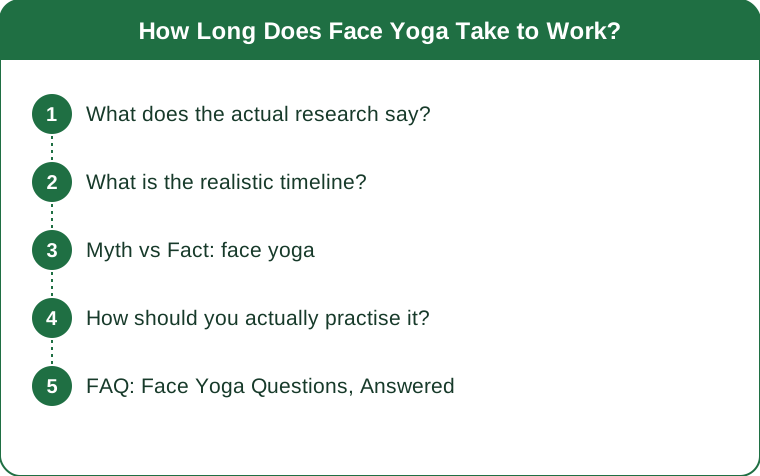
What does the actual research say?
There is far less of it than the popularity would suggest, and one study carries most of the weight.
The main reference point is a 2018 study conducted at Northwestern University, in which middle-aged women performed a structured facial exercise programme for 20 weeks — 30 minutes daily for the first 8 weeks, then every other day. Dermatologists assessing before-and-after photographs rated participants as looking younger, with the estimated improvement around three years, and the measurable change concentrated in upper and lower cheek fullness.
The important caveats: the sample was small, there was no control group performing a sham intervention, and adherence was high in a way that real-world practice rarely matches. The authors themselves described it as preliminary.
What it does support: that facial muscle exercise can produce a modest, measurable change in cheek volume over months. That is a real finding and it is more than most cosmetic practices can claim.
What it does not support: claims about wrinkles, skin texture, jawline definition, or eye area — none of which were the measured outcome. The mechanism is muscle hypertrophy, so the effect should be expected where there is muscle to build, and not elsewhere.
What is the realistic timeline?
Longer than the marketing suggests and shorter than a sceptic might guess.
Weeks 1-2: nothing visible. You will feel muscle fatigue and possibly mild soreness in the face, which is genuinely unfamiliar and is a reasonable sign that you are engaging the right muscles.
Weeks 3-6: still nothing visible in a mirror. This is where most people quit. Muscle hypertrophy anywhere in the body takes at least this long to produce visible change, and facial muscles are small, so the absolute change is small too.
Weeks 6-10: the first noticeable period. Participants in the study began reporting perceived change around week eight. What people typically notice first is a slight change in cheek fullness and a subjective sense of tone.
Weeks 10-20: the measurable window. This is where the study found its effect, and it required continued daily or near-daily practice throughout.
After 20 weeks: maintenance. Like any muscle adaptation, it is not permanent. Stopping means gradual reversion over a period of months.
The honest framing: this is a commitment measured in months of daily practice for a subtle result. That is a reasonable trade for some people and not for others, and knowing the actual numbers is what allows you to decide.

Myth vs Fact: face yoga
Myth: Face yoga removes wrinkles. Fact: The evidence points to muscle volume, not to skin. Wrinkles are primarily a function of collagen, elastin, sun damage, and repeated muscle folding — and for expression lines, more muscle activity could plausibly work against you rather than for you.
Myth: It is a natural alternative to injectables. Fact: They do opposite things. Injectables reduce muscle activity to soften expression lines. Face yoga increases muscle activity to build volume. Framing one as an alternative to the other misunderstands both.
Myth: More is better. Fact: The study protocol was 30 minutes daily, which is already substantial. There is no evidence that more produces more, and aggressive pulling on facial skin risks the opposite — repeated stretching of thin, delicate skin is not obviously benign.
Myth: It works the same at every age. Fact: The study population was middle-aged women, where age-related loss of facial fat and muscle volume gives the intervention something to address. In a twenty-five-year-old, there is less to restore, and the plausible benefit is correspondingly smaller.
Myth: Results appear in two weeks. Fact: No muscle in the body visibly hypertrophies in two weeks. Any two-week change is lighting, angle, hydration, or reduced facial puffiness — the last of which is real but is a different mechanism entirely and does not persist.
How should you actually practise it?
If you are going to do it, do the version the evidence describes rather than an improvised one.
Be consistent above all. Daily for the first eight weeks. This is the variable that mattered most in the study and it is the one most people compromise on first.
Use light pressure. Facial skin is thin and the underlying support structure is delicate. Exercises should engage muscle, not drag skin. If your fingers are pulling the skin around, you are doing something other than exercise.
Apply a slip. A facial oil or serum reduces friction where an exercise involves finger contact. This matters more than it sounds, because repeated dragging on dry skin over 20 weeks is a genuine concern.
Focus on the cheeks. That is where the evidence is. Exercises targeting the upper and lower cheek muscles have support; those claiming to lift eyebrows or eliminate neck lines do not.
Keep sessions to around 20-30 minutes and stop if you get facial or jaw discomfort. Anyone with TMJ or jaw problems should be cautious with anything involving strong jaw engagement, and should check with a professional first.
And keep the fundamentals in place. Daily sun protection, not smoking, sleep, and hydration have vastly more evidence for facial appearance than any exercise protocol. Face yoga is at best an addition to those, never a substitute. This is general information, not medical advice.
FAQ: Face Yoga Questions, Answered
Can it make things worse?
Potentially, in two ways. Repeated forceful skin manipulation is not clearly benign for thin facial skin, and increasing activity in muscles responsible for expression lines could theoretically deepen them. Light pressure and a cheek-focused protocol minimise both concerns.
Is a face yoga app or class worth it?
The value is in structure and adherence rather than in any proprietary technique. If paying for a programme makes you do it daily for twenty weeks, that is where the benefit comes from — because adherence is the variable that actually determined the result in the research.
Why does my face look better right after a session?
Temporary increased blood flow and reduced fluid retention. It is real, it feels encouraging, and it fades within an hour or two. It is not the same as the muscle adaptation, and mistaking one for the other is why people expect fast results.
TL;DR:
- The strongest evidence is one 20-week study finding modest cheek fullness improvement, rated at roughly three apparent years.
- Expect nothing visible before six to eight weeks; the measurable window in the research was weeks 10-20.
- The mechanism is muscle volume, not skin — it is not a wrinkle treatment and it is not an alternative to injectables.
- Use light pressure with a facial oil, focus on the cheeks, and keep sessions to 20-30 minutes daily.
- Effects require maintenance, and sun protection and sleep still matter far more than any exercise protocol.
It is a months-long commitment for a subtle result, and that is a reasonable trade for some people. This is general information, not medical advice.
Keep Reading
This article is for general informational and styling purposes only. Fit, sizing, and product availability may vary.