Facial Tension and Where You Hold It (Jaw, Brow, Eyes)
Quick Answer: Facial tension collects in three places: the masseter and temples (jaw clenching), the corrugator between the brows (screen focus and squinting), and the muscles around the eyes. The fastest release takes 60 seconds — part your teeth, drop your tongue off the roof of your mouth, soften between the brows, and look at something 20 feet away while you exhale slowly.
Right now, without changing anything: are your teeth touching? Is your tongue pressed against the roof of your mouth? Is there a small pinch between your eyebrows?
For most people reading this at a screen, the answer to at least two of those is yes — and it’s been that way for hours. That’s the strange thing about facial tension. A tight shoulder announces itself. A clenched jaw just quietly stays clenched all day.

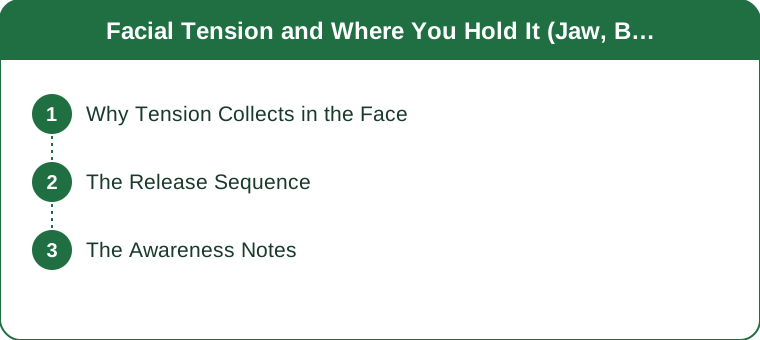
Why does tension collect in the face?
The face reacts to stress before anything else does. Facial muscles are unusually densely innervated and closely tied to emotional state. Before your shoulders creep up, your jaw has already set.
It’s completely unconscious. Nobody decides to clench. It happens below awareness, which means it can continue for eight hours without a single interruption.
Screens drive brow and eye tension specifically. Sustained close focus keeps the ciliary muscles in the eyes contracted and recruits the corrugator between the brows — the squint-and-concentrate muscle. Add a slightly too-small font and you’ve got a full workday of isometric holding.
Jaw clenching is extremely common, and often nocturnal. Plenty of people who insist they don’t clench are doing it while asleep. Waking up with a tight jaw, a dull temple ache, or teeth that feel “used” is the giveaway.
Nothing signals it. Facial muscles are small and lack the obvious mechanical consequences of, say, a tight hip. There’s no limp, no restricted reach. So it never crosses the threshold into conscious attention.

Where do you hold face tension? The three main sites
The jaw (masseter and temporalis). The masseter is the thick muscle you can feel bulge at the back of the jaw when you bite down. The temporalis fans across your temple. Both are strong, both fatigue quietly, and both refer discomfort into the head and ear.
Between the brows (corrugator and procerus). The concentration pinch. This is the site that responds fastest to a conscious release and re-tightens fastest the moment you stop paying attention.
Around the eyes (orbicularis oculi) plus the eyes themselves. Squinting, plus the internal focusing muscles held at close range for hours.
Secondary sites worth knowing: the tongue pressed hard against the palate (almost always paired with jaw clenching), and the muscles at the base of the skull where facial tension and neck tension meet.
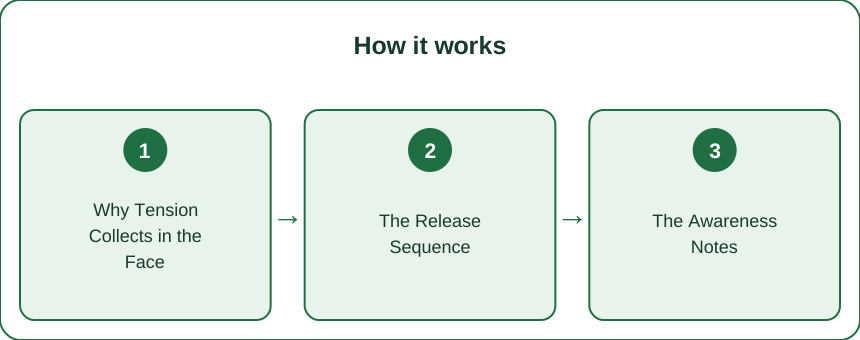
The 60-second release sequence
Do this in order. It takes about a minute and works at a desk without anyone noticing.
1. Notice first (10 seconds). Don’t fix anything yet. Just scan: teeth, tongue, brow, eyes. Naming what’s clenched is what makes it releasable.
2. Part the teeth. Let the jaw hang so there’s a small gap between upper and lower teeth. Lips can stay together. This is the resting position your jaw is supposed to be in and almost never is.
3. Drop the tongue. Let it fall off the roof of your mouth and rest on the floor of the mouth. Most people find they can’t unclench the jaw fully until the tongue lets go — the two are linked.
4. Soften between the brows. Not by raising the eyebrows — that’s a different tension. Just let the pinch go. Imagine the space widening.
5. Relax the eyes and look far away. Find something at least 20 feet off and let your focus soften onto it for 20 seconds. This releases the internal focusing muscles that no amount of face massage can reach.
6. Massage the jaw (30–60 seconds). Fingertips on the masseter, just in front of and below your ear. Small circles, moderate pressure. Then the temples. If you find a spot that’s tender, hold gentle pressure for 20 seconds rather than digging.
7. Exhale through it. Pair each release with a slow exhale, longer than the inhale. Roughly 4 seconds in, 6 out. The nervous system takes the hint.
What nobody tells you about facial tension
Releasing it feels wrong at first. An unclenched jaw feels slack and vaguely undignified if you’ve held it tight for years. That’s recalibration, not a mistake.
It comes back in about 90 seconds. One release doesn’t fix a pattern built over years. The value is in frequency, not depth — ten sloppy 30-second releases a day beat one thorough 10-minute session.
Chewing gum all day is not a release. It’s masseter training. If your jaw is already overworked, gum makes it worse.
Your phone posture is part of it. Looking down at a screen loads the neck, and the neck and jaw share fascia and nerve supply. Raising the phone to eye level does more for jaw tension than most jaw exercises.
The face is often the last place stress shows up as a symptom and the first place it shows up as a sign. Which means it’s a useful early-warning system, if you check it.
Building the awareness habit
Attach checks to things that already happen. Every time you unlock your phone. Every time you stop at a red light. Every time a meeting ends. You need a trigger, not willpower.
Put a physical cue at the screen. A small sticker at the corner of your monitor is genuinely effective for the first two weeks.
Check on waking. Morning jaw tightness, temple soreness, or a headache that’s present on waking are the strongest hints of nighttime clenching.
Check while driving. Traffic is a reliable clencher, and you have a mirror right there.
Address the stress, not only the symptom. Release work is real relief, but if the tension resets within minutes every time, the input hasn’t changed. Sleep, workload, and caffeine all show up in the jaw.
When to see a professional
See a dentist if you have persistent morning jaw pain, flattened or chipped teeth, or a partner who reports grinding — a night guard addresses a problem no amount of daytime awareness will reach. See a doctor or dentist for jaw clicking with pain, jaw locking, difficulty opening your mouth fully, or facial pain that’s persistent, one-sided, or worsening. Recurring headaches that don’t respond to these releases deserve a proper evaluation rather than more self-massage.
FAQ
How do I release face muscle tension fast?
Part your teeth, drop your tongue off the palate, soften the space between your brows, and look at something 20 feet away for 20 seconds while exhaling slowly. That’s about 60 seconds and hits all three main tension sites.
Why do I have knots in my face?
What feels like a “knot” is usually the masseter or temporalis muscle in sustained contraction — most often from clenching, day or night. Gentle circular massage plus consistent unclenching cues is the first-line approach; persistent tenderness or clicking warrants a dentist visit.
Can facial tension cause headaches?
Tension in the temporalis and masseter commonly refers into the temples and can contribute to tension-type headaches, and clenching is often part of that picture. If headaches are frequent, severe, or new, get them properly evaluated rather than treating them as a jaw problem by default.
TL;DR:
- Three tension sites: jaw (masseter/temples), between the brows, and around the eyes.
- It’s held unconsciously all day because, unlike a tight shoulder, it never signals.
- 60-second release: notice → part teeth → drop tongue → soften brow → look 20 feet away → massage jaw → slow exhale.
- The tongue on the palate and the clenched jaw release together — you usually can’t get one without the other.
- Frequency beats depth: ten short releases a day beat one long session.
- Morning jaw pain, worn teeth, jaw clicking, or persistent headaches are a dentist or doctor visit, not a self-massage problem.
Keep Reading
This article is for general informational and styling purposes only. Fit, sizing, and product availability may vary.