Why Your Face Looks Different the Week Your Schedule Changes
Quick Answer: A schedule change alters sleep position duration, fluid distribution and jaw tension at the same time, which is why the face looks different within days of the change and before anything else does. The practical response is lymphatic drainage in the morning, jaw release in the evening, and fixing the sleep timing itself - which is the underlying cause the other two are compensating for.
Five minutes in the morning does more than twenty minutes at night, for a specific reason involving where fluid goes when you lie down.
This is general information rather than medical advice.

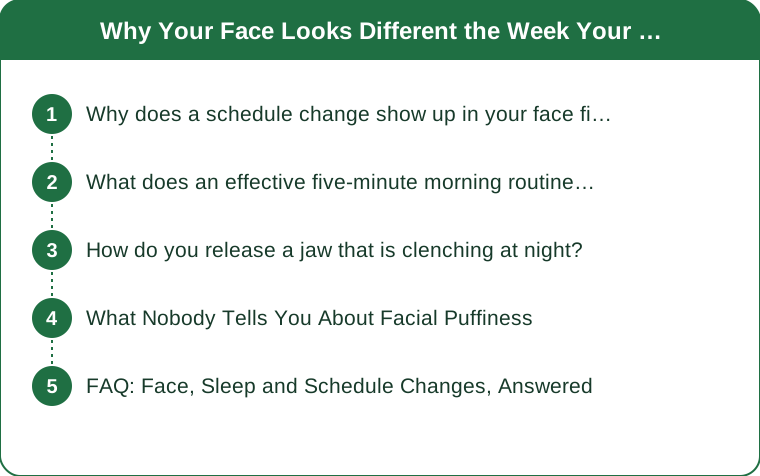
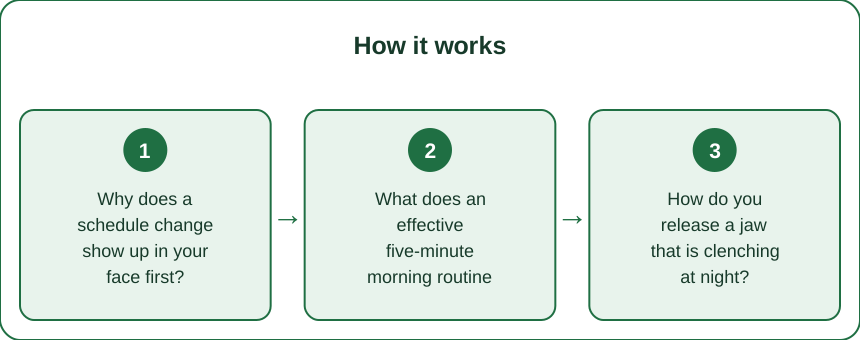
Why does a schedule change show up in your face first?
Because three things shift at once and the face is where all three are visible.
Fluid distribution. Lying down redistributes fluid toward the head, and the tissue around the eyes is thin with loose attachment, so it shows accumulation before anywhere else. When wake time moves earlier, you are getting up in the middle of that redistribution rather than after your body has begun clearing it.
Sleep depth and timing. A shifted schedule means going to bed before your circadian phase has moved. Lighter, more fragmented sleep is associated with more visible facial fluid retention and duller skin appearance - this has been shown in controlled sleep restriction studies where observers rated faces after restricted versus normal sleep.
Jaw tension. Schedule transitions raise stress, and the masseter is one of the most common sites for stress-related muscle tension. Clenching at night is very common during periods of change, and it produces both morning jaw soreness and, over weeks, a visibly fuller lower face.
Why it arrives so fast. Fluid effects appear within a single night. Jaw tension is visible within a week or two. Skin appearance changes take longer, which is why people notice the puffiness first and interpret the whole picture through it.
What is not happening. This is not a skin problem, and skincare products will not address it. It is a fluid and muscle problem with a sleep cause, which is why people who respond by buying eye cream see nothing change.
What does an effective five-minute morning routine look like?
Drainage direction and light pressure - both of which people get wrong in the same way.
The principle. Lymphatic vessels near the surface of the skin are extremely fine and respond to very light pressure - the weight of your fingers, no more. Firm massage compresses them closed and does the opposite of what is intended. This is the single most common mistake.
Direction always moves toward the drainage points, which sit in front of and below the ears and down the sides of the neck.
The sequence, five minutes:
- Neck first, 30 seconds. Light downward strokes from under the jaw to the collarbone, both sides. This opens the pathway - working the face before the neck pushes fluid toward a closed route, and it is why so many routines underdeliver
- Under the eyes, 60 seconds. Ring finger only, because it applies the least pressure naturally. From the inner corner outward toward the temple, then down in front of the ear. Ten light passes, no dragging
- Cheeks, 60 seconds. Flat fingers from the side of the nose out toward the ear, then down the neck
- Jawline, 90 seconds. From the chin along the jaw to the ear, then down. This is where to spend the extra time if the lower face is the concern
- Finish at the neck, 30 seconds. Repeat the opening strokes to clear what you have moved
Why morning rather than evening. Fluid accumulates overnight while horizontal. Morning is when there is something to move, and gravity assists for the rest of the day. Evening drainage work is largely wasted effort by comparison.
Things that help alongside it:
- A cold compress or chilled tool for 60 seconds before starting causes vasoconstriction and reduces swelling
- Sleeping with the head slightly elevated - one extra pillow or a slightly raised bed head - reduces overnight accumulation at source, which beats treating it afterwards
- Water first thing. Mild dehydration promotes fluid retention, which is counterintuitive and consistent

How do you release a jaw that is clenching at night?
Address the muscle and the trigger separately, because releasing tension without changing the cause lasts about a day.
The muscles involved:
- Masseter, the thick muscle you feel at the angle of the jaw when you bite down. The primary site
- Temporalis, at the temple, often responsible for the headache that accompanies clenching
- Pterygoids, deeper and less accessible, which is why some jaw tension does not respond to surface work
The release sequence, evening, five minutes:
- Find the masseter by clenching once and feeling the muscle bulge at the jaw angle. Then unclench
- Small circles with two fingers, moderate pressure, 60 seconds each side. Firmer than lymphatic work - this is muscle, not lymph
- Temples, 30 seconds each side, small circles
- The jaw drop. Tongue tip to the roof of the mouth just behind the front teeth, then let the jaw hang open as far as it will go without effort. Hold 30 seconds, repeat three times. This is the most effective single item here
- Finish with the resting position: lips together, teeth apart, tongue lightly on the palate. Teeth apart is the key part - most people rest with teeth touching, which is a low-grade clench
Addressing the trigger, which is the part that lasts:
- The teeth-apart resting position, checked several times a day. Attaching the check to a cue works better than remembering. This retrains the default position over weeks
- Screen and desk height, since forward head posture increases jaw muscle activity measurably
- Caffeine and alcohol timing, both of which increase night-time clenching
- The stress source itself, which during a schedule transition is usually temporary and worth naming as such
When to see a dentist rather than continue self-managing. Persistent morning headaches, tooth sensitivity or visible wear, jaw locking or clicking with pain, or ear pain without infection. A night guard is a straightforward solution for genuine nocturnal bruxism and protects the teeth, which massage does not.
What Nobody Tells You About Facial Puffiness
Sleep position matters more than any product. Side sleeping consistently produces more puffiness on the down-side of the face, and stomach sleeping produces the most overall. The asymmetry people notice between their two sides is very often just which side they sleep on.
Salt matters, and so does the timing. A high-sodium evening meal produces visible morning puffiness in many people. The effect is far stronger from an evening meal than from the same amount of sodium at lunch, simply because you then lie down on it.
Alcohol works through two mechanisms at once. It disrupts sleep architecture and it dehydrates, which triggers fluid retention. The next-day facial effect is disproportionate to the amount consumed and it is one of the most reliable observations people make about their own faces.
Crying, allergies and heat all produce the same appearance. Late summer is peak season for ragweed and other allergens in many regions, and allergic puffiness looks identical to sleep-related puffiness while responding to completely different things. If it comes with itchy eyes, it is not your schedule.
More pressure is not better and is actively worse. Superficial lymphatic vessels close under firm pressure. The correct pressure feels almost too light to be doing anything, which is why most people apply too much.
Consistency beats duration by a wide margin. Five minutes daily produces visible change within one to two weeks. Twenty minutes twice a week produces very little, because the effect is on fluid movement, which is a daily process rather than a cumulative one.
FAQ: Face, Sleep and Schedule Changes, Answered
Why is my face puffier since my schedule changed?
Earlier waking interrupts overnight fluid redistribution, and lighter sleep during a phase shift increases retention. Both effects appear within a night or two.
How much pressure should I use for lymphatic drainage?
Barely any - the weight of your fingers. Superficial lymphatic vessels are fine and close under firm pressure, so heavier massage does less, not more.
Morning or evening for facial massage?
Morning for drainage, because fluid has accumulated overnight and gravity assists afterwards. Evening for jaw release, because that targets clenching during sleep.
Why is one side of my face puffier?
Most often the side you sleep on. Side sleeping produces more fluid accumulation on the down side, and the asymmetry follows your habitual position.
How long until I see a difference?
Fluid changes are often visible the same morning. Consistent daily practice shows a clearer difference within one to two weeks. Jaw tension changes take longer.
When should I see a professional?
For persistent morning headaches, tooth wear or sensitivity, jaw clicking with pain, or ear pain without infection - see a dentist. Sudden or one-sided facial swelling warrants prompt medical attention.
TL;DR:
- Schedule changes shift fluid distribution, sleep depth and jaw tension at once, and the face shows all three
- Use the lightest possible pressure for drainage and always start at the neck to open the pathway
- Morning is for drainage, evening is for jaw release - the timing is not interchangeable
- Teeth apart, lips together, tongue on the palate is the resting position worth retraining
- Sleeping slightly elevated prevents overnight accumulation better than treating it afterwards
The puffiness is a symptom of the schedule, not of your skin. Fixing the sleep timing does more than anything you can do with your hands.
Keep Reading
This article is for general informational and styling purposes only. Fit, sizing, and product availability may vary.