Face Yoga When You Wear a Night Guard for Grinding
Quick Answer: A night guard is a dental protection device, not a treatment for the muscle activity. It stops enamel wear and cracked teeth, but the masseter and temporalis are still contracting all night - which is why people with guards still wake with jaw ache, temple headaches and morning stiffness. Face yoga helps with the muscular side specifically: gentle masseter and temporalis release, tongue-to-palate resting position, and lateral neck work. Avoid strong clenching exercises entirely, and do the release work in the morning rather than at night.
The dentist gave you a guard, the tooth wear stopped, and you still wake up with a jaw that feels like you have been chewing all night.
That is not the guard failing. It is the guard doing precisely the job it was designed for and no more.
The muscle side of grinding is a separate problem with separate tools, and most of them take under five minutes.

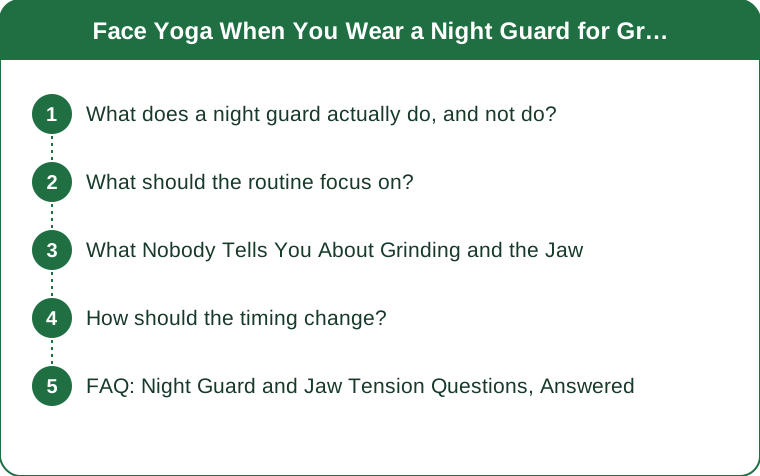
What does a night guard actually do, and not do?
It creates a physical barrier between your teeth. That is the whole mechanism.
Bruxism - grinding and clenching during sleep - produces very high forces, considerably higher than normal chewing, sustained over long periods. The damage shows up as flattened enamel, cracked or chipped teeth, and stressed restorations.
A guard interposes a layer of hard or soft material so the forces land on the appliance rather than the tooth surfaces. It is genuinely effective at that, and if you have a guard, wearing it is worth continuing.
What it does not do:
It does not stop the muscles contracting. The masseter and temporalis are still working. In some people, wearing a guard slightly reduces muscle activity; in others it does not change it at all; occasionally a poorly fitting guard increases it.
It does not address the morning symptoms that come from the muscle. Jaw ache, tightness in front of the ear, temple headaches, difficulty opening fully first thing - all of these come from sustained muscle contraction, not from tooth contact.
It does not treat the cause. Bruxism is associated with stress, sleep disturbance including sleep apnoea, certain medications, alcohol and caffeine. None of those are affected by an appliance.
So the useful framing is: the guard protects the teeth, and the muscular side is yours to manage. Those are different jobs and they need different tools.
What should the routine focus on?
Release and resting position, not strengthening. This is the critical distinction.
Most face yoga content is about toning - engaging muscles to build definition. For someone who grinds, the jaw muscles are already overworked, and adding resistance work to a masseter that has been contracting for seven hours is the wrong direction entirely.
Masseter release. The masseter is the thick muscle at the angle of the jaw. Find it by clenching gently once - you will feel it bulge just in front of and below the ear. Then unclench, and work it with the pads of two fingers in slow circles, gentle pressure, about thirty to sixty seconds per side. Slow and light beats deep and brief. If it is genuinely sore, less pressure.
Temporalis release. The fan-shaped muscle at the temple. Massage in slow circles with the fingertips, working upward and outward. This is where a large share of grinding-related headaches originate, and most people are surprised how tender it is the first time.
Tongue-to-palate resting position. The single most useful habit on this list. The tongue rests lightly on the roof of the mouth, teeth apart, lips together. Teeth apart is the whole point - the resting position of the jaw should have a small gap, and daytime clenchers have usually lost that.
Lateral neck and sternocleidomastoid. The neck is connected to jaw tension more directly than people expect, and side-of-neck tightness both contributes to and results from clenching. Slow lateral neck stretches, held twenty to thirty seconds.
And gentle opening range, not maximal. Slow controlled opening to a comfortable range, several times. Not the widest possible - that irritates the joint.

What Nobody Tells You About Grinding and the Jaw
Daytime clenching is often the bigger contributor and it is invisible to you. Many people who grind at night also clench during the day - at a screen, in traffic, while concentrating. Daytime clenching is fully within your control and it is where the fastest improvement comes from. The tongue-to-palate check, done a few times a day, is the intervention.
The masseter can visibly enlarge. Sustained heavy use hypertrophies it like any other muscle, which produces a squarer jawline over years. This is why some people notice their face shape changing and attribute it to weight. Releasing the muscle does not shrink it quickly, but reducing the workload stops the progression.
Morning headaches at the temples are usually muscular, not sinus. The temporalis refers pain into the temple and behind the eye, which is very commonly mistaken for a sinus or tension headache. If it is present on waking and eases through the morning, the jaw is the more likely source.
A guard that hurts is a guard that needs adjusting. New morning jaw pain after starting a guard, pain in a specific tooth, or a bite that feels different are all reasons to go back to the dentist rather than to push through. Ill-fitting guards can increase muscle activity rather than reducing it.
Sleep apnoea and bruxism travel together. There is a well-established association, and grinding can be a marker for disrupted breathing during sleep. If you also snore, wake unrefreshed, or have been told you stop breathing at night, that is worth raising with a doctor - it changes the whole picture and a guard does not address it.
And the seasonal one: grinding tends to worsen during periods of schedule change and stress. Late August and September - the return of school routines, work cycles restarting, sleep schedules shifting - is a reliably bad few weeks for jaw tension. If yours has been worse recently, that timing is not a coincidence.
How should the timing change?
Morning for release, evening for downregulation, and nothing intense before bed.
Morning is where the release work belongs. You wake with the muscle already loaded from a night of contraction. Two to three minutes of masseter and temporalis massage, done before or during your usual face routine, addresses the tension while it is present rather than pre-emptively.
A useful practical detail: do it after you take the guard out and rinse it, when the jaw has been in a fixed position for hours and moving it gently is exactly what it needs.
Evening should be about the nervous system rather than the muscle. Since bruxism is strongly stress-linked, the most useful pre-bed work is slow breathing, a warm compress on the jaw, and general downregulation. Vigorous jaw massage right before bed can leave the area feeling irritated, so keep it light.
A warm compress for five minutes before bed is one of the more reliably reported comfort measures and costs nothing.
Avoid strong clenching or resistance exercises at any time. This includes chewing gum for long periods, which is genuinely counterproductive for a grinder - it is resistance training for the exact muscle you are trying to calm.
Reduce evening caffeine and alcohol. Both are associated with increased bruxism. Alcohol in particular fragments sleep architecture in a way that correlates with more grinding, which is why a heavy evening often produces a bad jaw morning.
And check in during the day. Set a reminder if you need to. The question is: are my teeth touching right now? If they are, and you are not eating, that is a clench - and catching it is the highest-value thing in this whole routine.
FAQ: Night Guard and Jaw Tension Questions, Answered
Will face yoga stop me grinding?
No, and it is worth being clear about that. Bruxism during sleep is not under voluntary control, so no exercise routine stops it. What the routine does is manage the muscular consequences - the ache, the stiffness, the temple headaches - and reduce daytime clenching, which for many people is a substantial part of the total load. Those are real benefits, but they are symptom management rather than a cure.
Should I stop wearing my guard if I do jaw exercises?
No. The guard protects your teeth from a force that exercises do not reduce. Keep wearing it and treat the muscle work as a separate, additional thing. If the guard itself is causing pain or your bite feels changed, that is a reason to see your dentist for an adjustment, not a reason to stop wearing it.
How hard should I press when massaging the masseter?
Much less than most people assume. The target is a slow, moderate pressure that feels like a release rather than a deep tissue treatment - if you are wincing, it is too much. Thirty to sixty seconds per side, gently, done consistently every morning, does considerably more than an occasional aggressive session. Sharp pain, pain in the joint itself rather than the muscle, clicking with pain, or the jaw locking are all reasons to stop and get it assessed.
This is general information, not medical or dental advice. Persistent jaw pain, locking, or a changed bite should be assessed by a dentist or doctor.
TL;DR:
- A night guard protects teeth and does not stop the muscles contracting - which is why the morning ache persists.
- Focus on release and resting position, never on strengthening. The masseter is already overworked.
- The core routine: masseter massage, temporalis massage, tongue-to-palate with teeth apart, lateral neck stretch.
- Release in the morning, downregulation in the evening, nothing vigorous before bed.
- Daytime clenching is the part you can actually control - and checking in a few times a day is the highest-value habit here.
The guard is doing its job. The muscle side is a separate job, and it takes about three minutes a morning.
Keep Reading
This article is for general informational and styling purposes only. Fit, sizing, and product availability may vary.