Face Yoga vs Facial Rolling: Are They Actually Doing the Same Thing?
Quick Answer: Face yoga primarily works through active muscle engagement — repeated contraction and release intended to build facial muscle tone over time, similar in principle to resistance exercise elsewhere in the body — while facial rolling primarily works through passive lymphatic drainage and temporary blood flow increase, producing more immediate but shorter-lived de-puffing and glow effects rather than the slower, muscle-tone-focused change face yoga aims for.
They’re not competing methods doing the same job differently, they’re targeting genuinely different mechanisms, which is why combining both is common rather than viewing them as alternatives to pick between.
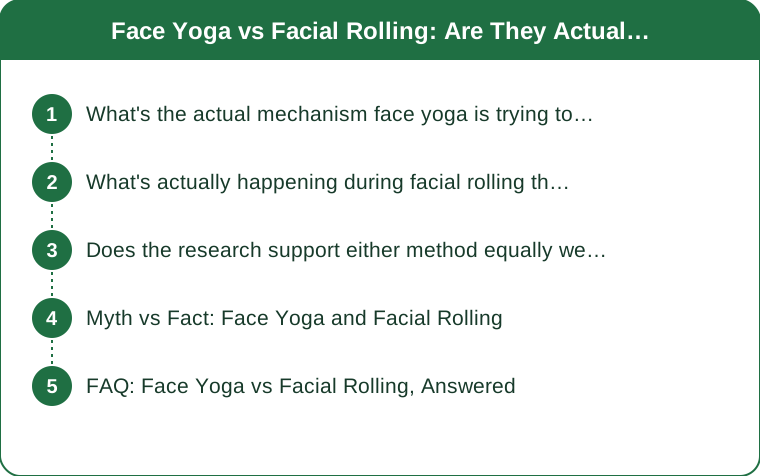
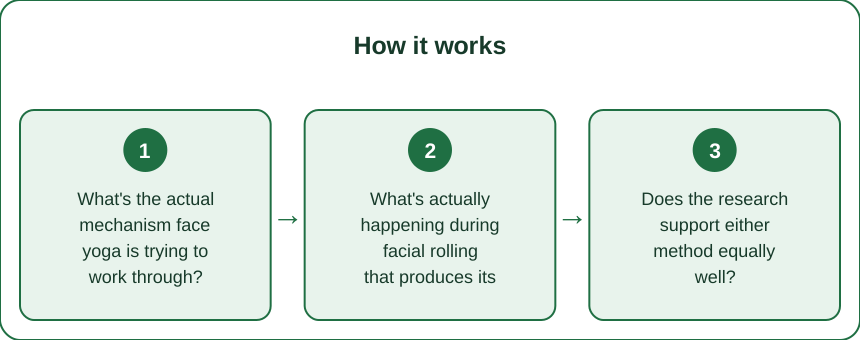
What’s the actual mechanism face yoga is trying to work through?
Face yoga exercises involve repeated, intentional contraction of specific facial muscle groups, following the same general principle as resistance training for the body — the theory being that consistent muscle engagement over weeks and months can build some degree of tone and firmness in the facial muscles.
What’s actually happening during facial rolling that produces its visible effect?
Facial rolling applies gentle pressure and rolling motion that temporarily increases local blood flow and can help move lymphatic fluid, which is why it often produces a fairly immediate de-puffing or glow effect, though this effect is largely temporary since it’s not changing the underlying muscle or tissue structure the way sustained exercise aims to.

Does the research support either method equally well?
Face yoga has some emerging research support for modest improvements in facial muscle tone and perceived age with consistent long-term practice, while facial rolling’s research support is more limited and centers mainly on short-term circulation and de-puffing effects rather than lasting structural change.
Myth vs Fact: Face Yoga and Facial Rolling
Myth: Facial rolling builds muscle tone the same way face yoga does. Fact: Rolling primarily affects circulation and lymphatic flow temporarily, not muscle tone, which is a fundamentally different mechanism.
Myth: Since they work differently, only one is worth actually doing. Fact: Many people use both together specifically because they target different, complementary effects rather than redundant ones.
FAQ: Face Yoga vs Facial Rolling, Answered
Is there a recommended order for using both in the same routine?
Some practitioners recommend rolling first to increase circulation and prep the muscles, followed by face yoga exercises, though there’s no strict rule and either order can work.
How long does it typically take to notice results from face yoga specifically?
Most sources suggest several weeks to a few months of consistent daily practice before noticeable muscle tone changes, similar to the timeline for building tone anywhere else in the body.
Does facial rolling have any effect that lasts beyond the same day?
The circulation and de-puffing effect is largely temporary and typically fades within hours to a day, which is why it’s often used as a regular ritual rather than a one-time treatment.
TL;DR:
- Face yoga works through active muscle engagement aimed at longer-term tone change
- Facial rolling works through passive circulation and lymphatic effects with more immediate but temporary results
- Face yoga has somewhat more research support for lasting structural change over time
- The two methods are commonly used together since they target different, complementary mechanisms
Face yoga and facial rolling aren’t really alternatives to choose between — they’re different tools addressing different parts of how facial appearance can shift over time.
Keep Reading
This article is for general informational and styling purposes only. Fit, sizing, and product availability may vary.