Face Yoga After a Summer of Sun — What It Can and Cannot Address
Quick Answer: Face yoga targets facial muscle tone and can produce modest, gradual changes in fullness and firmness with consistent practice. It does nothing for sun damage, which is a skin-level issue involving collagen breakdown, pigmentation, and elastin degradation. After a summer of sun exposure, the useful interventions are sun protection, retinoids, and dermatological treatments — with face yoga as an unrelated addition, not a substitute.
September is when people look in the mirror and notice what a summer of sun actually did.
Face yoga is genuinely worth doing for what it does. It is worth being clear about what that is.

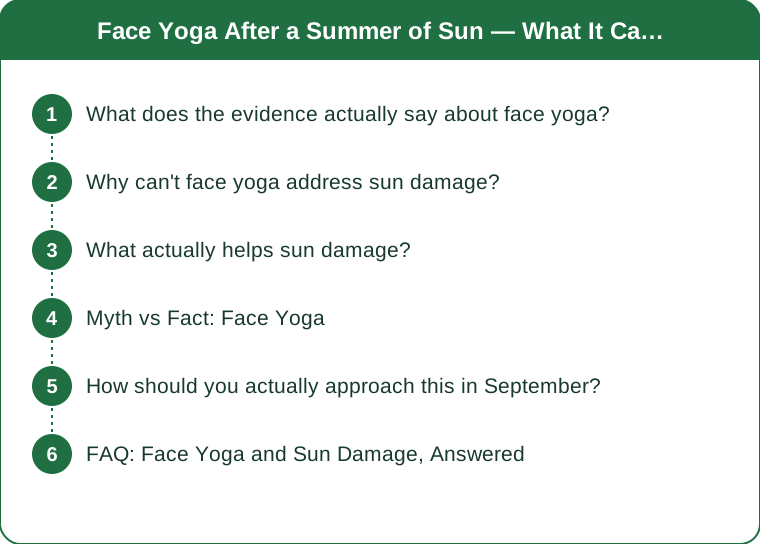
What does the evidence actually say about face yoga?
The honest answer: limited but not nothing.
The most-cited study on facial exercise is a small trial in which middle-aged women followed a structured 30-minute daily facial exercise program for 20 weeks. Dermatologists assessing before-and-after photographs rated the participants as appearing modestly younger, with the most consistent improvement in upper and lower cheek fullness.
What is important about those results:
- The mechanism appears to be muscle, not skin. Facial muscles, like any muscle, can hypertrophy with resistance, and increased muscle volume in the cheeks reads as fullness.
- The commitment was substantial — 30 minutes daily initially, and the study was small with no control group receiving a sham intervention. That is a meaningful limitation.
- The improvement was modest, described in terms of a few years of apparent age, not a transformation.
What that supports: facial exercise may improve muscle tone and midface fullness with consistent, long-term practice.
What it does not support: claims about wrinkle removal, jawline definition through fat reduction, lifting sagging skin, or any effect on pigmentation or texture. Those are skin and structural properties, and muscle training does not address them.
The useful frame: face yoga is strength training for facial muscles. It does what strength training does — builds the muscle — and it does not do what skincare does.
Why can’t face yoga address sun damage?
Because sun damage happens in a completely different tissue layer than the one facial exercise affects.
What UV exposure actually does:
- Breaks down collagen in the dermis, which is the structural protein providing skin firmness. This is the primary mechanism of photoaging and it accounts for the large majority of visible skin aging.
- Damages and disorganizes elastin, which is what allows skin to recoil. Degraded elastin produces the crepey, loose texture characteristic of sun-exposed skin.
- Triggers uneven melanin production, producing sunspots and mottled pigmentation.
- Thickens and coarsens the outer layers over time, changing texture.
- Damages DNA in skin cells, which is the mechanism behind skin cancer risk.
Every one of those is in the skin. Facial exercise works on muscle beneath the skin. Building the muscle underneath a sun-damaged dermis changes the volume underneath; it does not repair collagen, redistribute pigment, or restore elastin.
An analogy that holds up: building your quadriceps does not change a scar on your thigh. Both are real, both are worth attention, and they are separate systems.
One caution specific to this topic: some face yoga techniques involve repeatedly creasing the skin, and there is a reasonable theoretical concern that aggressive, repetitive skin manipulation could contribute to lines over time — particularly on skin already weakened by sun damage. Use light pressure, avoid dragging or pulling the skin, and always work on moisturized or oiled skin rather than dry.
What actually helps sun damage?
The interventions with real evidence, in rough order of impact.
1. Sun protection, starting now. This is the highest-value item by a wide margin. Photoaging is cumulative, and protection prevents further damage while allowing some natural repair processes to proceed. Broad-spectrum SPF 30 or higher, applied daily and reapplied when outdoors, plus hats and shade. September and October still carry meaningful UV exposure — the perception that sun protection is a summer activity is one of the more costly misconceptions in skincare.
2. Topical retinoids. Retinoids — prescription tretinoin and over-the-counter retinol — have the strongest evidence base of any topical for photoaging. They increase collagen production, improve texture, and reduce pigmentation over months of consistent use. Start low and slow, expect an adjustment period, and use them at night with sun protection during the day.
3. Vitamin C serums, which have reasonable evidence for antioxidant protection and modest brightening.
4. Consistent moisturization, which improves barrier function and the appearance of texture, though it does not repair structural damage.
5. Professional treatments for established damage — chemical peels, laser resurfacing, and microneedling all have evidence for improving photoaged skin, and all require a qualified provider and realistic expectations.
What to be skeptical of: anything promising to reverse years of damage quickly, collagen supplements marketed with dramatic claims, and any device or exercise claiming to replace sun protection.
And importantly: a summer of significant sun exposure is a good reason for a skin check. Any new mole, a mole that has changed in size, shape, or color, a sore that does not heal, or a spot that itches or bleeds should be seen by a dermatologist. This is general information, not medical advice.

Myth vs Fact: Face Yoga
Myth: Face yoga can replace skincare. Fact: They address entirely different tissue layers. Muscle training does not affect collagen, pigmentation, or texture, and skincare does not build muscle. Doing one does not substitute for the other.
Myth: Face yoga tightens sagging skin. Fact: Sagging involves skin laxity, fat pad descent, and bone changes over time. Increasing muscle volume can create a fuller appearance, which some people perceive as lifting, but the skin itself is not tightened by muscle exercise.
Myth: Face yoga causes wrinkles. Fact: This is overstated but not baseless. The concern is with aggressive, repetitive skin creasing and dragging rather than with facial exercise as a category. Light pressure on moisturized skin avoids the plausible mechanism.
Myth: You will see results in two weeks. Fact: The study most often cited required 20 weeks of near-daily practice for modest changes. Any protocol promising visible results in weeks is describing temporary swelling from increased circulation, not structural change.
Myth: Facial massage and face yoga are the same thing. Fact: They are different practices with different mechanisms. Massage primarily addresses circulation, temporary puffiness, and muscle tension. Face yoga is resistance exercise for muscle. Both are legitimate; they do different things.
Myth: Results stay if you stop. Fact: Muscle adaptations reverse with detraining, in the face as elsewhere. Whatever gains come from facial exercise require ongoing practice to maintain — which is a reasonable trade if you enjoy the practice and a poor one if you do not.
How should you actually approach this in September?
A realistic plan that puts each thing where it belongs.
The skin priorities, which do the heavy lifting:
- Daily broad-spectrum sunscreen, continuing through fall and winter. UV exposure does not stop when the weather cools.
- Introduce or restart a retinoid, which is best begun in autumn as UV exposure decreases and skin is less reactive. Start twice weekly and build up.
- A gentle, consistent routine — cleanse, moisturize, protect — rather than an aggressive one. Barrier damage from over-treatment is common after summer.
- A dermatologist visit if you had significant sun exposure, particularly for a skin check.
Where face yoga fits, if you want to do it:
- Treat it as its own practice with its own modest goal: facial muscle tone and midface fullness.
- 10 to 15 minutes daily is a realistic commitment, and consistency matters far more than duration.
- Always on moisturized or oiled skin, with light pressure and no dragging.
- Give it 12 to 20 weeks before evaluating, and take a photograph at the start in consistent lighting, because gradual change is nearly impossible to assess from memory.
- Skip it if you have active acne, rosacea flares, recent injectables, or any inflamed skin condition — manipulation can aggravate all of those. Check with your provider if you have had recent cosmetic procedures.
The honest bottom line: if you enjoy the practice, it is a pleasant ritual with a plausible modest benefit and little downside when done gently. If you are doing it hoping to undo sun damage, you will be disappointed, and the effort is better spent on sunscreen and a retinoid.
This is general information, not medical advice. Skin concerns, changing moles, or persistent skin changes warrant a dermatologist rather than a self-directed routine.
FAQ: Face Yoga and Sun Damage, Answered
Does face yoga actually work?
For facial muscle tone and midface fullness, there is limited supporting evidence from a small study requiring 20 weeks of near-daily practice for modest results. For wrinkles, pigmentation, texture, or skin laxity, there is no good evidence.
Can I undo a summer of sun damage?
Not fully, but you can improve it and stop it getting worse. Daily sun protection and a topical retinoid are the two interventions with the strongest evidence, and professional treatments can address established damage.
Will face yoga give me wrinkles?
Aggressive, repetitive skin creasing is a plausible concern, particularly on sun-damaged skin. Use light pressure on moisturized skin and avoid dragging, and the mechanism largely goes away.
How long before I see anything?
Plan for 12 to 20 weeks of consistent daily practice, and take a starting photograph in consistent lighting. Anything visible within two weeks is circulation and temporary swelling, not structural change.
Should I do face yoga instead of buying skincare?
No — they do different things. If you have to choose one, sunscreen has far more evidence behind it than any facial exercise protocol.
TL;DR: Face yoga works on muscle. Sun damage happens in skin. They are separate problems.
- The evidence for face yoga is a small 20-week study showing modest improvement in cheek fullness — a muscle effect, not a skin effect.
- Sun damage is collagen breakdown, elastin degradation, and pigmentation in the dermis. Facial exercise does not reach it.
- What does help: daily broad-spectrum sunscreen year-round, topical retinoids, vitamin C, and professional treatments for established damage.
- Autumn is the right time to start a retinoid, as UV exposure decreases.
- If you do face yoga: light pressure, moisturized skin, 10 to 15 minutes daily, and judge at 12 to 20 weeks with a starting photo.
- Get a skin check after a summer of significant sun exposure — any new or changing mole needs a dermatologist.
Sunscreen and a retinoid do the work. Face yoga is a pleasant addition, not a substitute.
Keep Reading
This article is for general informational and styling purposes only. Fit, sizing, and product availability may vary.