Is Mouth Taping for Face Yoga Actually Safe, or Just a Trend Gone Too Far?
Quick Answer: Mouth taping (taping the lips shut during sleep to encourage nasal breathing) is not the same thing as face yoga, and its safety depends heavily on individual factors like nasal congestion, sleep apnea risk, and skin sensitivity — it’s not inherently dangerous for most healthy people with clear nasal breathing, but it’s also not something with strong evidence behind the jawline and facial benefits often claimed for it, and it should never be tried by anyone with undiagnosed sleep apnea or significant nasal congestion.
The trend has gotten tangled up with face yoga content, but the two practices and their evidence bases are genuinely different things.

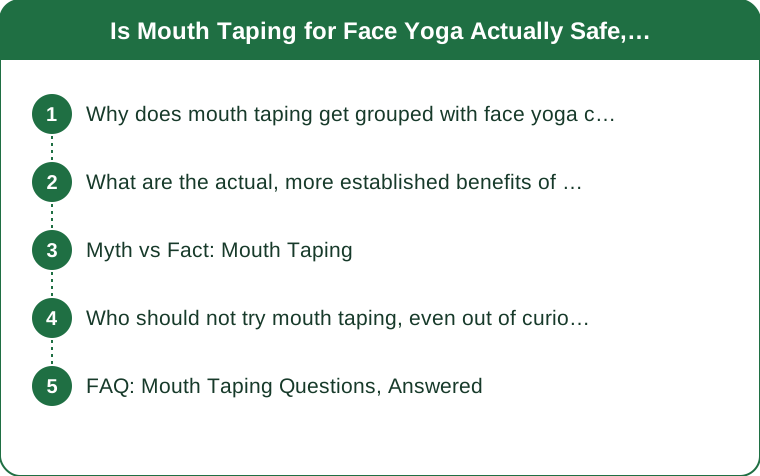
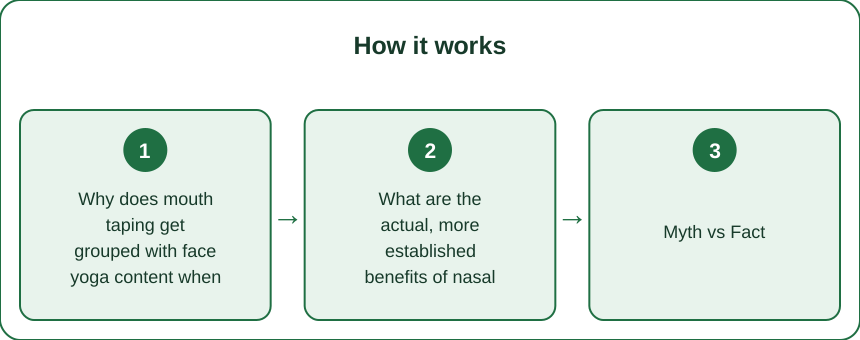
Why does mouth taping get grouped with face yoga content when it’s a different practice?
Mouth taping and face yoga often appear together in the same wellness content because they’re both framed as low-cost, at-home facial improvement practices, but they work through completely different mechanisms — face yoga uses targeted muscle engagement, while mouth taping is about breathing pattern, not muscle exercise. The claimed jawline and facial tone benefits of mouth taping specifically have much weaker evidence behind them than face yoga’s muscle-engagement claims.
What are the actual, more established benefits of nasal breathing during sleep?
Nasal breathing during sleep is genuinely associated with better sleep quality and reduced snoring for many people, since nasal breathing filters and humidifies air more effectively than mouth breathing and is linked to more stable oxygen levels overnight. This is the more evidence-backed reason people try mouth taping — not the facial or jawline benefits that often get attached to it in social content.

Myth vs Fact: Mouth Taping
Myth: Mouth taping visibly improves jawline definition over time. Fact: There’s minimal direct evidence for this specific claim — the more supported benefit is sleep quality and breathing pattern, not facial muscle change.
Myth: Mouth taping is safe for everyone to try. Fact: It can be genuinely risky for people with undiagnosed sleep apnea, significant nasal congestion, or certain respiratory conditions, since it can restrict airflow during sleep in a way that matters medically.
Myth: If tape falls off easily, it means you don’t need it. Fact: Tape falling off can simply mean it wasn’t applied correctly or your skin type doesn’t hold standard tape well — it’s not a reliable signal either way about your breathing pattern.
Who should not try mouth taping, even out of curiosity?
Anyone with diagnosed or suspected sleep apnea, chronic nasal congestion, allergies affecting nasal breathing, or a deviated septum should not try mouth taping without first talking to a doctor, since restricting mouth breathing in these cases can genuinely impair overnight oxygen intake rather than improve sleep. Skin sensitivity is a smaller but real concern too — some tapes cause irritation, especially with nightly repeated use.
FAQ: Mouth Taping Questions, Answered
Is there a safer alternative for people curious about nasal breathing benefits without taping?
Yes — practicing conscious nasal breathing while awake, and addressing nasal congestion directly (saline rinses, allergy treatment) can improve nighttime nasal breathing without the need for tape at all.
Does mouth taping actually help with snoring for most people?
For people whose snoring is specifically caused by mouth breathing (not other causes like sleep apnea or throat anatomy), it can help — but snoring has multiple possible causes, so it’s not a universal fix.
Should you combine mouth taping with face yoga practices?
There’s no evidence one enhances the other’s effects — they’re separate practices with separate (and separately supported) benefits, so combining them doesn’t add particular value beyond doing either individually.
TL;DR:
- Mouth taping and face yoga are different practices with very different evidence bases
- The more supported benefit of mouth taping is sleep quality, not facial/jawline change
- It’s not safe for people with sleep apnea, nasal congestion, or certain respiratory conditions
- Addressing nasal congestion directly is a safer starting point than taping for most people
This is general information, not medical advice — check with a doctor before trying mouth taping if you have any breathing or sleep-related conditions.
Keep Reading
This article is for general informational and styling purposes only. Fit, sizing, and product availability may vary.