Why Face Yoga Barely Helps If Your Screen Posture Is the Problem
Quick Answer: A forward head posture shifts the load on the muscles under your jaw and along the front of your neck, so those muscles sit in a shortened, tense position for most of the day. Face yoga worked on top of that fights an eight-hour input with a five-minute one. Fix the screen height and the chin position first, and the same face yoga routine starts producing results it was not producing before.
This is the most common reason a consistent routine produces no visible change, and it has nothing to do with the exercises themselves.

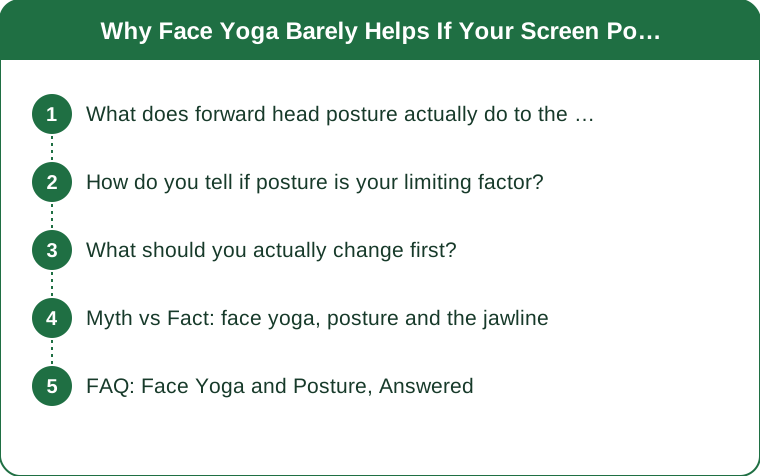
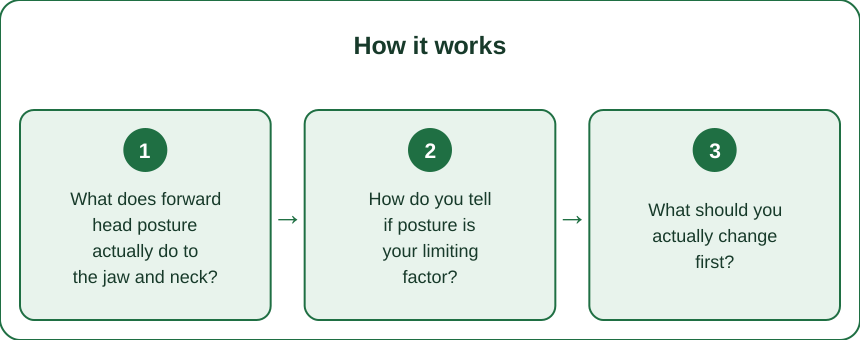
What does forward head posture actually do to the jaw and neck?
When your head drifts forward of your shoulders, the deep neck flexors at the front of the neck lengthen and weaken, while the muscles under the chin and along the jawline take on stabilizing work they were not designed to do continuously.
The visible consequence is a jaw and submental area that sits under low-grade tension all day, plus skin along the front of the neck held in a slightly compressed position for hours.
The functional consequence is that when you then perform a face yoga movement targeting the jawline, you are asking an already fatigued, chronically shortened muscle group to work more. That is not usually how you improve tone.
The mechanical detail that matters: the further forward the head sits, the more effective load the neck structures carry, and screen use is the single largest driver of that position in most adults. Eight hours of that input against five minutes of targeted exercise is not a fair contest.
How do you tell if posture is your limiting factor?
Three checks, none of which require equipment.
The wall test. Stand with heels, hips and upper back against a wall. If the back of your head does not touch comfortably without you tilting your chin up, your resting head position is forward.
The end-of-day comparison. Look at your jaw and neck in the morning and again at 6pm. If the difference is pronounced, the day is doing something to it, and the day is mostly screens.
The one-sided tell. If tension or definition differs noticeably between sides, check whether your monitor sits off-center, whether you hold a phone to one ear, or whether you sleep face-down toward one side. Asymmetric input produces asymmetric results, and no exercise routine corrects for an environmental asymmetry that keeps repeating.
If all three point the same way, the highest-value change is your desk, not your routine.

What should you actually change first?
Monitor height. The top of the screen at or just below eye level. This is the single largest change and it is usually free - a stack of books works.
Phone position. Bring the phone up rather than dropping the head down. Most people spend more time in a severe forward position on a phone than on a laptop, and the angle is much worse.
Chin tucks, hourly. Not the face yoga kind - the postural kind. Gently draw the chin straight back, hold five seconds, release. Ten repetitions takes 50 seconds and directly strengthens the deep neck flexors that a forward posture weakens.
Laptop users need a stand and an external keyboard. A laptop cannot be at both correct screen height and correct hand height simultaneously. There is no posture fix that resolves this geometry.
Then, and only then, keep doing the face yoga. The routine is not wrong. It was competing with a much larger input.
Myth vs Fact: face yoga, posture and the jawline
Myth: Face yoga can correct a jawline shaped by posture. Fact: it can improve muscle tone and circulation, and it cannot reposition a head that spends eight hours forward. The posture is the upstream variable.
Myth: The double chin is entirely about body fat. Fact: submental appearance is a combination of fat, skin laxity, muscle tone and head position - and head position is the one that changes in seconds and gets ignored.
Myth: More repetitions produce faster results. Fact: overworking already-tense facial muscles is a recognized way to create more tension, not less. Consistency at moderate volume beats intensity here more clearly than in almost any other kind of training.
Myth: Results should show in two weeks. Fact: realistic timelines for visible change from facial exercise run to several months of near-daily practice, and studies in this area are small. If the posture input is still there, the timeline extends indefinitely.
Myth: Once posture is fixed, it stays fixed. Fact: it is a position you hold, not a state you achieve. The hourly chin tuck and the correct monitor height are ongoing, which is why environment beats effort here.
FAQ: Face Yoga and Posture, Answered
How long after fixing my desk setup should I expect a difference?
Tension along the jaw and front of the neck often eases within one to two weeks. Visible change in definition takes considerably longer and depends on the same factors as any facial exercise program - several months of consistency is a realistic frame.
Should I stop face yoga while I work on posture?
No. Keep the routine and add the postural work. The point is that the routine was being outcompeted, not that it was useless.
Does sleeping position matter as much as screen posture?
It matters, particularly for one-sided differences, but you spend fewer hours asleep than at a screen for most people and you have less control over it. Fix the screen first because the return is larger and more immediate.
This is general information, not medical advice. Persistent neck pain, numbness or headaches should be assessed by a healthcare professional.
TL;DR:
- Forward head posture keeps the jaw and neck muscles under continuous low-grade tension for hours a day.
- A five-minute routine cannot outweigh an eight-hour input, which is why consistent face yoga sometimes produces nothing.
- Fix monitor height, raise the phone, and add hourly chin tucks before adding more facial exercise.
- Asymmetric results usually point to an asymmetric environment - an off-center monitor, a phone side, a sleeping position.
The routine was probably fine. It was working against a bigger number, and moving your screen up four inches changes that number more than any exercise on the list.
Keep Reading
This article is for general informational and styling purposes only. Fit, sizing, and product availability may vary.