Face Yoga for Glasses Wearers: Where the Tension Actually Builds
Quick Answer: Glasses create facial tension in three predictable places: the corrugator muscles between the brows from squinting through a slightly wrong prescription, the temples from frame pressure, and the small muscles around the eyes from the frame edge sitting in the visual field. The most effective response is not more face yoga - it is checking the prescription and fit first, then releasing what remains. Face yoga applied to a tension pattern caused by a bad fit does not solve it.
You take your glasses off at the end of the day and there are two marks on your nose.
That is the visible part. The part you feel is between your eyebrows.
Glasses change the map of facial tension, and the usual routines are not aimed at where it lands.

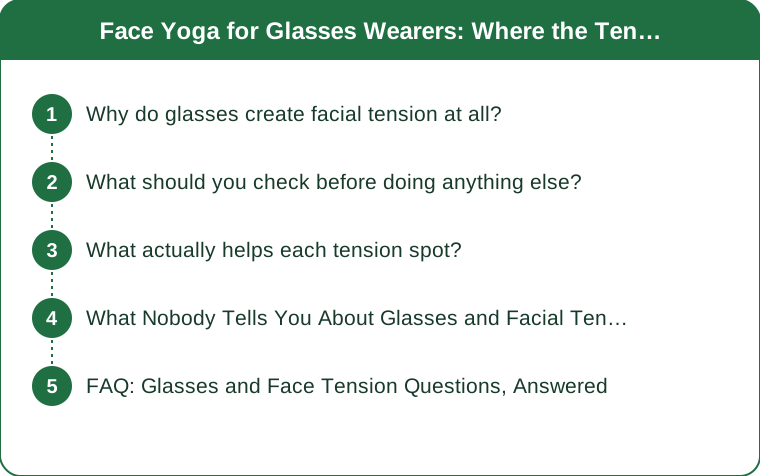
Why do glasses create facial tension at all?
Three separate mechanisms, and they produce different tension patterns.
Pressure is the obvious one. Frames rest on the nose bridge and behind the ears, applying constant low-level load for however many hours you wear them. Constant low-level pressure produces a different tissue response than intermittent high pressure - the tissue adapts to it, and you stop noticing while the tension continues.
Visual effort is the bigger one and the one people miss. A prescription that is slightly off, or lenses that are dirty or scratched, makes you squint. Squinting recruits the orbicularis oculi around the eye and the corrugator between the brows, and unlike frame pressure this is active muscular effort sustained for hours.
Frame position adds a third. Progressive and varifocal lenses require specific head positioning to use the right part of the lens, which frequently means holding the chin slightly up or down. A sustained head position loads the neck, and neck tension refers into the jaw and temples reliably.
The result is a distinctive pattern: tension between the brows, at the temples, at the nose bridge, and often in the upper neck - a different distribution from the jaw-dominant tension that most face yoga content addresses.
The important implication: two of these three causes are fixed by an optician rather than by exercises. Working on the tension without addressing the cause means doing it forever.
What should you check before doing anything else?
Prescription age, frame fit and lens cleanliness, in that order.
Prescription first. If your prescription is more than about two years old, or if you find yourself squinting, moving closer to screens, or getting headaches by mid-afternoon, that is the likely cause and no exercise addresses it. Squinting from an under-corrected prescription is sustained muscular effort for the whole day.
Frame fit second, and it is more specific than it sounds:
- The bridge should distribute weight across the nose rather than concentrating on two points. Deep red marks mean pressure is concentrated, and an optician can adjust the pads in a couple of minutes
- Temple arms should follow the head without gripping. Tightness at the temples produces exactly the headache people assume is eye strain
- Frames should sit level. A tilted frame makes you compensate with head position, which is where the neck involvement comes from
Lens cleanliness is trivial and genuinely matters. Smeared or scratched lenses cause low-grade squinting all day. People clean them far less often than the effect justifies.
Screen distance is worth a mention too. Progressive wearers often position screens so the reading portion of the lens is in use, which means chin up for hours. Lowering the monitor so the top of the screen is at or below eye level fixes a lot of glasses-related neck and temple tension on its own.
Do these first. Then the exercises are releasing residual tension rather than fighting an ongoing cause.

What actually helps each tension spot?
Three targeted releases, and none of them take more than a minute.
For between the brows - the corrugator area:
Place your index fingers just above the inner ends of the eyebrows. Apply gentle pressure and hold while consciously relaxing the brow for about 30 seconds. Then draw the fingers slowly outward along the brow line toward the temples, three or four times.
The key is the conscious relaxation rather than the pressure. Chronic corrugator tension is a habit of holding, and pressure alone does not release a habit - noticing does.
For the temples:
Fingertips at the temples, small slow circles, moderate pressure, for around 30 seconds each side. Then open the jaw slowly while maintaining the contact. The temporalis extends up into the temple region and is a jaw muscle, which is why jaw movement changes what you feel there.
For the nose bridge:
Take the glasses off. Pinch gently at the bridge, then use small circular movements on either side of the nose where the pads sit, for about 20 seconds. Follow with three slow deep breaths through the nose, which also relieves any pressure sensation in the sinuses.
When to do them: mid-afternoon is the highest-value time, because that is when accumulated tension peaks and when a bad prescription is doing the most work. A second round at the end of the day helps with the evening headache pattern.
A general principle worth stating: more pressure is not better. Facial tissue is thin and the muscles involved are small. Firm enough to feel, gentle enough to relax into, is the correct amount.
What Nobody Tells You About Glasses and Facial Tension
Five things that change the approach.
The tension is usually asymmetric, and so is your face. Most people have slight facial asymmetry and most frames sit slightly unevenly as a result. You will typically find one side markedly more tender than the other, and that side needs more attention rather than an equal amount.
Contact lens wearers get a different pattern. No frame pressure, and often more eye-area tension from dryness-related squinting. If you alternate between glasses and contacts, the tension map alternates too.
Screen height is a facial tension variable. A monitor too high forces chin elevation, which loads the neck, which refers into the temples and jaw. For progressive wearers this is one of the largest single factors, and it costs nothing to fix.
The marks on your nose are not the problem. Visible indentation is a pressure sign and it is not what causes the headache. The corrugator squinting is doing far more, and it leaves no mark at all - which is why people fixate on the wrong thing.
Face yoga cannot fix an optical problem, and this is the one that matters most. If the tension pattern returns within an hour every single day, the cause is ongoing and it is almost certainly prescription or fit. Exercises are for residual tension, not for a live cause - and doing them instead of seeing an optician is the most common mistake in this whole area.
FAQ: Glasses and Face Tension Questions, Answered
Will face yoga reduce the marks on my nose?
Not really - those are a pressure effect from the frame and the fix is an adjustment at the optician, which usually takes minutes and costs nothing. Massage relieves the soreness but does not change the pressure.
Why do I get headaches in the afternoon specifically?
Accumulated squinting and frame pressure, with fatigue lowering your tolerance for both. Afternoon-only headaches that clear overnight are a fairly typical pattern for an under-corrected prescription and worth mentioning at your next eye test.
Do lighter frames help?
Often yes for nose bridge pressure, since less weight is concentrated at the pads. They do not affect the squinting component at all, which is usually the larger contributor.
Should I do these exercises with my glasses on or off?
Off, for all three. You need direct access to the nose bridge and temples, and taking them off is itself a useful break from the pressure.
Can face yoga replace an eye test?
No, and this is worth being clear about. Persistent eye strain, headaches or a change in vision are reasons to see an optometrist. Exercises address muscular tension, not the optical cause producing it.
TL;DR:
- Glasses create tension in three places: between the brows from squinting, at the temples from frame pressure, and at the nose bridge
- Two of the three causes are fixed by an optician, not by exercises - check prescription age, frame fit and lens cleanliness first
- Screen height matters a lot for progressive wearers; lower the monitor so the top is at or below eye level
- Corrugator release works through conscious relaxation more than pressure
- Temple work should include slow jaw opening, since the temporalis is a jaw muscle
- Expect asymmetry and treat the tender side more
If the tension is back within an hour every day, stop massaging and book an eye test.
Keep Reading
This article is for general informational and styling purposes only. Fit, sizing, and product availability may vary.