Face Yoga After Botox or Fillers: What Actually Changes
Quick Answer: After botulinum toxin, the treated muscles are partly or fully unable to contract, so exercises targeting them do nothing for several weeks to months — and vigorous massage in the first day or two can theoretically spread the product. After dermal filler, firm massage over the treated area can displace product while it is still settling. The practical rule most practitioners give is: no facial massage or intensive face yoga for 24 to 48 hours after toxin and about two weeks after filler, then resume with the treated areas mapped out.
If you have been doing face yoga for a while and then have a treatment, nobody hands you a revised routine. The aftercare card says avoid lying down and avoid the gym, and says nothing at all about the ten minutes you spend on your jaw every morning.
The two do interact, in fairly specific ways, and it is worth understanding them rather than guessing.
This is general information, not medical advice — your injector knows your treatment and should be the one you ask.

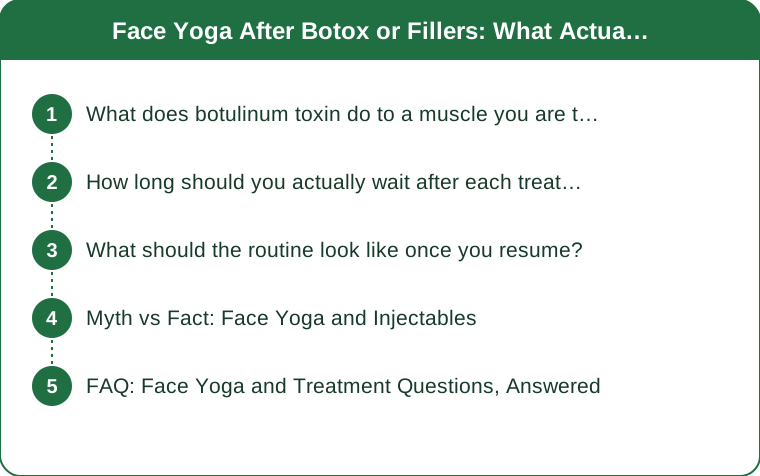
What does botulinum toxin do to a muscle you are trying to train?
It blocks the signal that tells it to contract.
Botulinum toxin works at the neuromuscular junction, preventing the release of acetylcholine — the chemical messenger that carries the instruction from nerve to muscle. The muscle is intact and healthy; it simply is not receiving the message. Over the following weeks and months the nerve endings regenerate and function returns, which is why the effect wears off.
For face yoga this has one clear consequence: an exercise that targets a treated muscle cannot train it. If you have had the frontalis treated and your routine includes forehead work, that portion of the routine is inert until the effect fades. Not harmful — inert. There is no evidence that trying to contract a treated muscle either speeds up or slows down the return of function.
There is a subtler point that matters more. Facial muscles work in opposing groups, and when one group is quiet the others often start doing more. People who have had the glabellar complex treated frequently find they are recruiting more from the forehead, or from around the eyes, without noticing. If your face yoga practice was previously balancing tension across those groups, that balance has changed and the routine should change with it.
The practical version: after toxin, spend a week noticing what your face actually does before deciding what to practice. The map you had is out of date.
How long should you actually wait after each treatment?
The two treatments have different timelines and different reasons.
After botulinum toxin: most injectors advise no rubbing, massage or facial manipulation of the treated area for 24 hours, and many say 48. The concern is diffusion — the product spreading beyond where it was placed before it has bound locally, which is the mechanism behind unwanted effects like a dropped brow or eyelid. The evidence that gentle massage causes this is not strong, but the consequence if it happens is a months-long cosmetic problem, so the caution is reasonable.
Light, non-treated-area work — neck, lower face if untreated — is generally considered fine after the first day. Ask your injector, because placement varies.
After dermal filler: the usual advice is around two weeks before firm massage over the treated area. The reasoning is different. Filler is a gel placed in a specific plane, and it takes time to integrate with the surrounding tissue. Firm, directional pressure during that window can theoretically displace it — and the result is not that it disappears, it is that it ends up somewhere you did not want it. Gentle skincare application is fine almost immediately; it is sustained directional pressure that is the concern.
Gua sha and facial rolling deserve a specific mention, because they apply exactly the kind of sustained directional pressure that is at issue. Both are commonly advised against for longer than manual massage — often four weeks over filler sites — and they are the tools people are least likely to think of as massage.
Lymphatic drainage work is generally the gentlest category and is sometimes actively recommended after treatment to reduce swelling. It is still worth confirming with the person who did the injecting.

What should the routine look like once you resume?
Map the face, then adjust three things.
Map it. Write down which muscles were treated and roughly when. You now have three zones: treated and inert, untreated and working, and the neck, which almost nobody treats and almost everybody neglects. This map is valid for about three to four months and then needs redoing.
Adjust one: drop the strengthening work on treated muscles. Not because it is harmful, because it is pointless, and because the time is better spent elsewhere. Come back to it as function returns — you will feel the muscle start to respond, which is a surprisingly clear signal.
Adjust two: move the emphasis to release rather than contraction. The parts of face yoga that involve releasing tension — jaw, temples, the muscles around the ear, the base of the skull — are unaffected by either treatment and are where most people carry the tension that actually shows. This is also the part of the practice with the most defensible rationale in the first place.
Adjust three: give the neck the time you have freed up. The platysma runs from the collarbone up over the jaw, and its tone genuinely affects the jawline. It is almost never treated in a standard toxin appointment, it responds to training, and it is the most commonly skipped part of every routine. If you have had upper-face treatment and lost half your routine, this is where the time should go.
One thing not to do: compensate with more intensity elsewhere. Overworking the untreated muscles to make up for the quiet ones is how people create the asymmetries they later complain about.
Myth vs Fact: Face Yoga and Injectables
Myth: Face yoga will make your botox wear off faster. Fact: There is no good evidence for this. The duration of effect is determined by nerve terminal regeneration, not by how much you try to use the muscle. The persistent belief that exercise burns it off appears to come from an unrelated observation — that people with faster metabolisms and more expressive faces sometimes report shorter duration — and it has not held up as advice.
Myth: If you do face yoga you will not need injectables. Fact: They do different things. Toxin reduces dynamic lines caused by muscle contraction. Filler adds volume. Face yoga primarily affects muscle tone and tension, and to a lesser extent circulation. The honest summary of the evidence for face yoga is a small number of studies showing modest improvement in perceived fullness with a lot of consistency over months. Presenting it as a substitute oversells what it has been shown to do.
Myth: Massage after filler helps it settle. Fact: Your injector may specifically instruct you to massage a particular lump — that is a targeted instruction, not general permission. Unprompted massage during the settling window is one of the more common ways people end up back in the chair.
Myth: You should stop face yoga entirely if you get treatments. Fact: There is no reason to. The release work, the neck work, and everything below the treated zones continue to make sense. What changes is which exercises are doing anything.
FAQ: Face Yoga and Treatment Questions, Answered
Can I do face yoga before a treatment?
Yes, right up to the day. There is no reason to stop beforehand. If anything, arriving with less jaw and temple tension makes the assessment easier.
How will I know the toxin is wearing off?
You will start to feel the muscle respond during exercises that previously did nothing, usually before the lines return visibly. Face yoga practitioners often notice this weeks before they would have otherwise, which is a genuine minor benefit of having a practice.
What about microneedling or lasers?
Different timeline again, and generally stricter on the skin surface — most protocols say nothing touching the face for several days while the barrier recovers. Face yoga involves a lot of hands-on-face, so it is worth asking specifically.
Is there any risk to just doing gentle work on untreated areas the same day?
Most injectors are comfortable with work well away from the injection sites after a few hours, but this depends entirely on where you were injected and how much. It is a one-line question at the end of the appointment and it is worth asking while you are still in the chair.
This is general information, not medical advice. Always follow the aftercare given by the practitioner who performed your treatment, and contact them if anything looks or feels wrong.
TL;DR:
- Treated muscles cannot contract, so exercises aimed at them do nothing until function returns over the following months.
- Wait 24 to 48 hours after toxin and about two weeks after filler before firm facial massage; longer for gua sha and rollers.
- Map which zones are treated, then shift the routine toward release work and the neck.
- Face yoga does not burn off toxin, and it is not a substitute for either treatment.
- Ask your injector the specific question before you leave the appointment — it takes ten seconds.
If you take one thing from this: the freed-up time is best spent on the platysma and the jaw release work. It is the part of a face yoga routine with the most going for it and the part that gets skipped first.
Keep Reading
This article is for general informational and styling purposes only. Fit, sizing, and product availability may vary.